At a glance
- ACE-031 (ramatercept) is a soluble ActRIIB-Fc fusion protein engineered by Acceleron Pharma to inhibit myostatin and related growth-restricting ligands
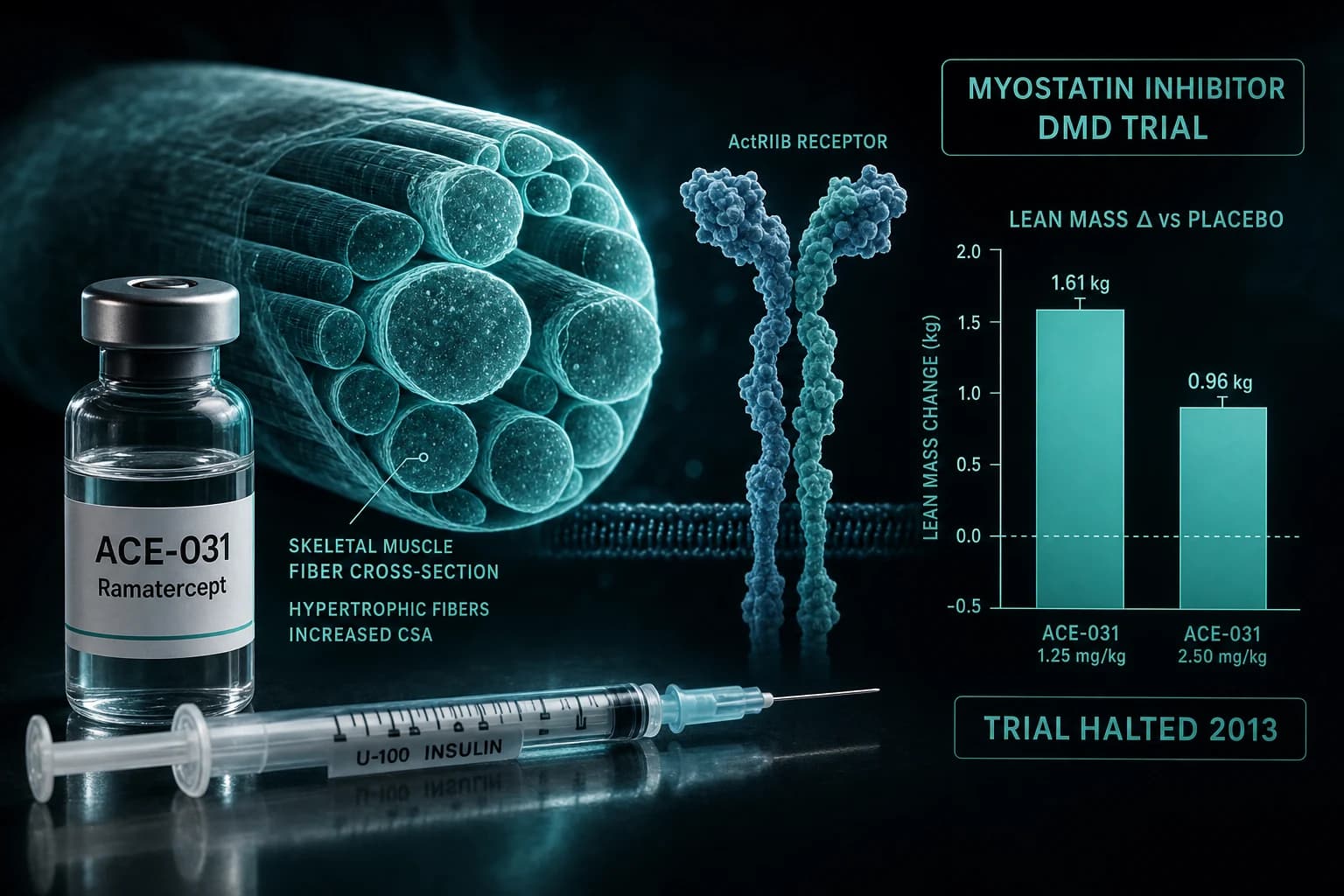
- Phase 2 DMD trial (Campbell et al., Muscle Nerve, 2017) showed trends for lean mass and 6-minute walk test improvement but was halted due to non-muscle adverse events (epistaxis, telangiectasias)
- Acceleron and Shire concluded their collaboration on ACE-031 in May 2013; development of this specific molecule was not resumed
- Mechanism: binds myostatin (GDF-8), activin A, and GDF-11 to block signaling at ActRIIB receptors on muscle cells, removing the growth-restriction brake
- ACE-031 itself is not commercially developed; research-grade availability is limited and the regulatory pathway is uncertain
ACE-031 is the most-studied myostatin inhibitor that did not reach the finish line. The soluble ActRIIB-Fc fusion protein produced measurable lean mass and walk-test trends in Duchenne muscular dystrophy boys, but the Phase 2 trial was halted in 2013 due to non-muscle adverse events that the sponsor judged to be unfavorable for continued development. The compound remains a research-grade reference point for myostatin inhibition therapy, but is not commercially developed and the original sponsor (Acceleron) has not resumed work on it.
This article covers what ACE-031 actually is at the molecule level, the Phase 2 trial that established both its efficacy potential and its safety concerns, the broader myostatin inhibition field that has emerged since 2013, and how researchers should think about ACE-031 as a study compound in 2026.
What ACE-031 actually is
ACE-031 (development name ramatercept) is a fusion protein constructed from the extracellular ligand-binding domain of the human ActRIIB receptor and the Fc region of human IgG1. The molecular result is a soluble decoy receptor that binds myostatin and related TGF-β superfamily ligands in circulation before they can engage their cell-surface receptors on muscle cells.
| Property | ACE-031 value |
|---|---|
| Format | Soluble ActRIIB-Fc fusion protein |
| Length | Extracellular ActRIIB domain + IgG1 Fc |
| Ligands bound | Myostatin (GDF-8), activin A, GDF-11 |
| Mechanism | Decoy receptor; sequesters ligands from cell-surface ActRIIB |
| Route | Subcutaneous injection |
| Half-life | Extended via Fc region (weeks) |
| Developer | Acceleron Pharma (later partnered with Shire) |
| Approved indication | None |
The "decoy receptor" design is the key. Native myostatin signals through ActRIIB on muscle cells to suppress muscle growth and maintain a homeostatic balance. By introducing a circulating ActRIIB without downstream signaling, the engineered protein sequesters myostatin away from muscle cells. The brake on muscle growth is effectively removed.
The same general design has been pursued by multiple sponsors with different fusion protein architectures. Sotatercept (a different Acceleron compound for pulmonary hypertension) uses a different receptor domain. ACE-2494, follistatin-based decoys, and several biotech programs have explored variations.
The Phase 2 DMD trial
The pivotal published clinical evidence for ACE-031 comes from a Phase 2 randomized placebo-controlled trial in ambulatory boys with Duchenne muscular dystrophy (Campbell et al., Muscle Nerve, 2017).
| Parameter | Trial details |
|---|---|
| Population | Ambulatory boys with DMD |
| Route | Subcutaneous, every 2-4 weeks |
| Design | Randomized, double-blind, placebo-controlled, ascending-dose |
| Primary endpoint | Safety |
| Pharmacodynamic endpoints | Lean mass (DXA), 6-minute walk test, fat mass, BMD |
| Outcome | Halted after second dosing regimen |
The published Phase 2 results showed pharmacodynamic trends favoring ACE-031:
Lean mass. Total body lean mass increased modestly in the ACE-031 arms versus placebo. The effect was in the expected direction given the myostatin inhibition mechanism.
Fat mass. A small reduction in fat mass was observed.
6-minute walk test. Trends favored ACE-031 but the trial was not powered for clinically meaningful detection.
Bone mineral density. Some changes were observed but interpretation was constrained by the trial size and duration.
These pharmacodynamic trends were the part of the trial that suggested ACE-031 was producing the expected biology. The reason the trial was halted was not efficacy failure.
Why the trial was halted
The Phase 2 DMD trial was halted after the second dosing regimen due to safety findings unrelated to muscle:
Epistaxis. Nosebleeds occurred at higher rates in the ACE-031 arms than placebo.
Telangiectasias. Small dilated blood vessels visible on skin surface emerged or worsened in some ACE-031 patients.
The mechanism behind these findings is consistent with off-target binding of ACE-031 to BMP9 and BMP10 (TGF-β family ligands that play roles in vascular biology). The ActRIIB-Fc design was not perfectly selective for myostatin; the decoy receptor also bound vascular biology ligands and produced unintended effects.
Acceleron Pharma and Shire announced in May 2013 that they would conclude their collaboration on ACE-031 and related molecules. The development of this specific fusion protein was not resumed.
Bottom line: ACE-031 demonstrated myostatin inhibition works for muscle in humans, but the specific molecular design produced vascular side effects that ended its development pathway. The compound is a research-grade reference rather than a clinical-pipeline candidate.
The myostatin inhibition field since 2013
ACE-031's discontinuation did not end myostatin inhibition development. Several successor compounds and approaches have emerged:
Bimagrumab. Novartis bimagrumab is a monoclonal antibody targeting ActRIIB. It has been tested in obesity, sarcopenia, and metabolic syndrome contexts. The compound has shown lean mass increases and fat mass decreases but development has been intermittent.
Trevogrumab. Regeneron trevogrumab is a monoclonal anti-myostatin antibody. Trials have been conducted in various muscle wasting and metabolic contexts.
Domagrozumab. Pfizer domagrozumab is another anti-myostatin antibody. Phase 2 DMD trial was negative on primary endpoint.
Apitegromab. Scholar Rock apitegromab specifically inhibits latent myostatin (pro-myostatin) rather than mature myostatin. The selectivity claim is that this approach avoids the off-target binding that affected ACE-031 and other ActRIIB-targeted compounds. Apitegromab is in Phase 3 for spinal muscular atrophy.
Sotatercept (related but different). Sotatercept is a different fusion protein (ActRIIA-Fc rather than ActRIIB-Fc) developed by Acceleron primarily for pulmonary arterial hypertension. It was approved in 2024 for PAH and is not a myostatin inhibitor in the same direct sense as ACE-031.
For broader context on muscle-targeting research peptides outside the myostatin pathway, see the BPC-157 compound guide, TB-500 dosage guide, and the IGF-1 LR3 research dosing protocol for IGF-1 pathway approaches.
ACE-031 research-grade availability
Unlike many research peptides where retail availability is straightforward, ACE-031 has a more complicated picture:
-
Original molecule: The fusion protein produced by Acceleron during the clinical program is not commercially available.
-
Research-grade analogs: Some peptide vendors list "ACE-031" as a research compound. The molecular identity, purity, and biological equivalence to the original Acceleron molecule varies and is not always verified through public COA documentation.
-
Folkstatin-like products: Some vendors offer follistatin-related products that target similar muscle pathways through different mechanisms.
For research applications targeting myostatin inhibition specifically, the published clinical evidence is largely from compounds like ACE-031 and bimagrumab that are not retail-available. Research-grade peptide work targeting muscle hypertrophy via myostatin pathway has limited reproducibility because the validated molecules are not the retail products.
For more directly available muscle-pathway research peptides, the Follistatin 344 myostatin pathway research covers an alternative mechanism, and the IGF-1 LR3 research dosing protocol covers an entirely different muscle-growth pathway.
What researchers should know
Three practical takeaways:
1. Myostatin inhibition produces measurable muscle effects in humans. The ACE-031 Phase 2 trial established this. The challenge is achieving the muscle benefit without off-target effects on vascular biology or other tissues that share TGF-β family receptors.
2. Selectivity matters more than potency. The successor compounds (apitegromab, latent-myostatin-selective programs) emphasize selectivity over potency precisely because the ACE-031 lesson was that broad ActRIIB binding produces unintended off-target effects.
3. The retail "ACE-031" market is not equivalent to the clinical molecule. Researchers expecting to replicate the Phase 2 trial findings with retail product should expect substantial variability. The published clinical evidence describes a specific protein from Acceleron's manufacturing program, not generic research-grade peptide synthesis.
How this connects to Enhanced Games athlete protocols
The Enhanced Games (May 21-24, 2026) athlete protocols generally do not include myostatin inhibitors. The disclosed protocols focus on recovery peptides (BPC-157, TB-500), growth hormone secretagogues (CJC-1295, Ipamorelin), and testosterone bases. Myostatin inhibition is an evidence-thinner adjacent area where the clinical-grade molecules (ACE-031, bimagrumab) are not retail-available and the retail-grade alternatives have uncertain bioequivalence.
For the Enhanced Games athlete-protocol context, see the Enhanced Games May 24 article.
Sourcing
Research-grade ACE-031 availability varies significantly by vendor and is not consistently documented through public COAs. For more reliable research-grade muscle-pathway compounds, Ascension Peptides carries BPC-157, TB-500, and the growth-hormone secretagogue compounds with 50% off using code ENHANCED and published per-batch COAs.
For our broader sourcing analysis, see the best legit peptide vendors 2026 ranking.
FAQ
What is ACE-031?
ACE-031 (development name ramatercept) is a soluble ActRIIB-Fc fusion protein developed by Acceleron Pharma. It binds myostatin and related growth-restricting ligands to block their signaling at ActRIIB receptors on muscle cells, removing the brake on muscle growth.
Did ACE-031 work?
In the Phase 2 DMD trial, ACE-031 produced pharmacodynamic trends consistent with myostatin inhibition: lean mass increase, fat mass decrease, walk-test trends favorable. The trial was halted before the efficacy endpoints could be definitively characterized, but the biology that the compound was designed to produce was observable in humans.
Why was the ACE-031 trial halted?
Non-muscle adverse events including epistaxis (nosebleeds) and telangiectasias (small dilated surface blood vessels) emerged in the ACE-031 arms. These are consistent with off-target binding of the ActRIIB-Fc fusion protein to BMP9/BMP10 vascular biology ligands. Acceleron and Shire concluded the collaboration on ACE-031 in May 2013.
Is ACE-031 available now?
Research-grade peptide vendors list ACE-031 in their catalogs. Molecular identity, purity, and biological equivalence to the original Acceleron fusion protein varies and is not consistently documented through public COAs. Patients and researchers should not expect retail "ACE-031" to be the same molecule that was studied in the Phase 2 DMD trial.
Are there better myostatin inhibitors now?
Several successor compounds have entered development, including bimagrumab (Novartis), trevogrumab (Regeneron), domagrozumab (Pfizer, negative Phase 2), and apitegromab (Scholar Rock, targeting latent myostatin selectively). Apitegromab is the most-advanced clinical program currently active.
Can I use ACE-031 to build muscle?
ACE-031 is not approved for any indication, and the research-grade availability is unreliable. The Phase 2 trial in healthy adult volunteers (Attie et al., 2013) showed mild lean mass changes but the program was discontinued before any definitive efficacy or safety conclusions were reached. Using retail "ACE-031" for athletic muscle building is not a validated protocol and carries unknown safety risk.
Does myostatin inhibition cause cardiovascular problems?
The ACE-031 trial halt was driven by vascular side effects (epistaxis, telangiectasias) that appear to reflect off-target binding of the ActRIIB-Fc fusion protein to BMP9/BMP10 ligands involved in vascular biology. Selective myostatin inhibitors that avoid this off-target binding may have different safety profiles. The cardiovascular question is mechanism-dependent rather than universal to all myostatin pathway interventions.
Further reading
- Follistatin 344 myostatin pathway research
- Hexarelin GHRP dosing and cortisol risk guide
- IGF-1 LR3 research dosing protocol
- Sermorelin vs CJC-1295 vs Ipamorelin comparison
- TB-500 dosage guide
- Wolverine Stack: BPC-157 + TB-500 recovery protocol
- Enhanced Games May 24 2026 opening-day stacks and stakes
- Best legit peptide vendors 2026
This article is for educational and research purposes only. ACE-031 (ramatercept) was investigated in Phase 2 clinical trials in Duchenne muscular dystrophy but the program was discontinued in 2013 due to non-muscle adverse events. No FDA-approved indication exists. Research-grade availability is variable and bioequivalence to the original Acceleron molecule is not consistently documented. None of the content above constitutes medical advice.