At a glance
- Bryan Johnson served as the Enhanced Games' on-air 'Human Enhancement Analyst' alongside Emmanuel Acho and Abby Labar (May 24, 2026, Resorts World Las Vegas).
- His own Blueprint protocol is the opposite shape: 40+ daily oral supplements, no current TRT, no published injectable peptide stack, calorie restriction at ~10%.
- Enhanced Games athletes (e.g., James Magnussen) stack supraphysiological testosterone with injectable BPC-157, TB-500, CJC-1295, Ipamorelin, Thymosin α-1 for short-term peak.
- Convergence is small but real: both lean on Thymosin family peptides (athletes inject TB-500, Johnson uses Tβ4 in topical/serum form) and prioritize collagen + recovery markers.
- The broadcast's existence does more for legitimacy than for any single compound. PED-adjacent peptide use is now mainstream-adjacent.
On Sunday night in Las Vegas, the man trying hardest in human history not to die sat in a broadcast booth and explained the supraphysiological protocols of athletes trying hardest to win.
Bryan Johnson, founder of Blueprint and the subject of the 2025 Netflix documentary Don't Die: The Man Who Wants to Live Forever, served as the inaugural Enhanced Games' "Human Enhancement Analyst" alongside host Emmanuel Acho and co-host Abby Labar. His on-air job: translate each athlete's enhancement protocol into plain terms for viewers in real time. The broadcast streamed live from Resorts World Las Vegas at 8:30 PM ET / 5:30 PM PT on Roku, Rumble, YouTube, Twitch, and Kick.
The selection is interesting because Johnson's own protocol runs in the opposite direction from almost everyone he was analyzing.
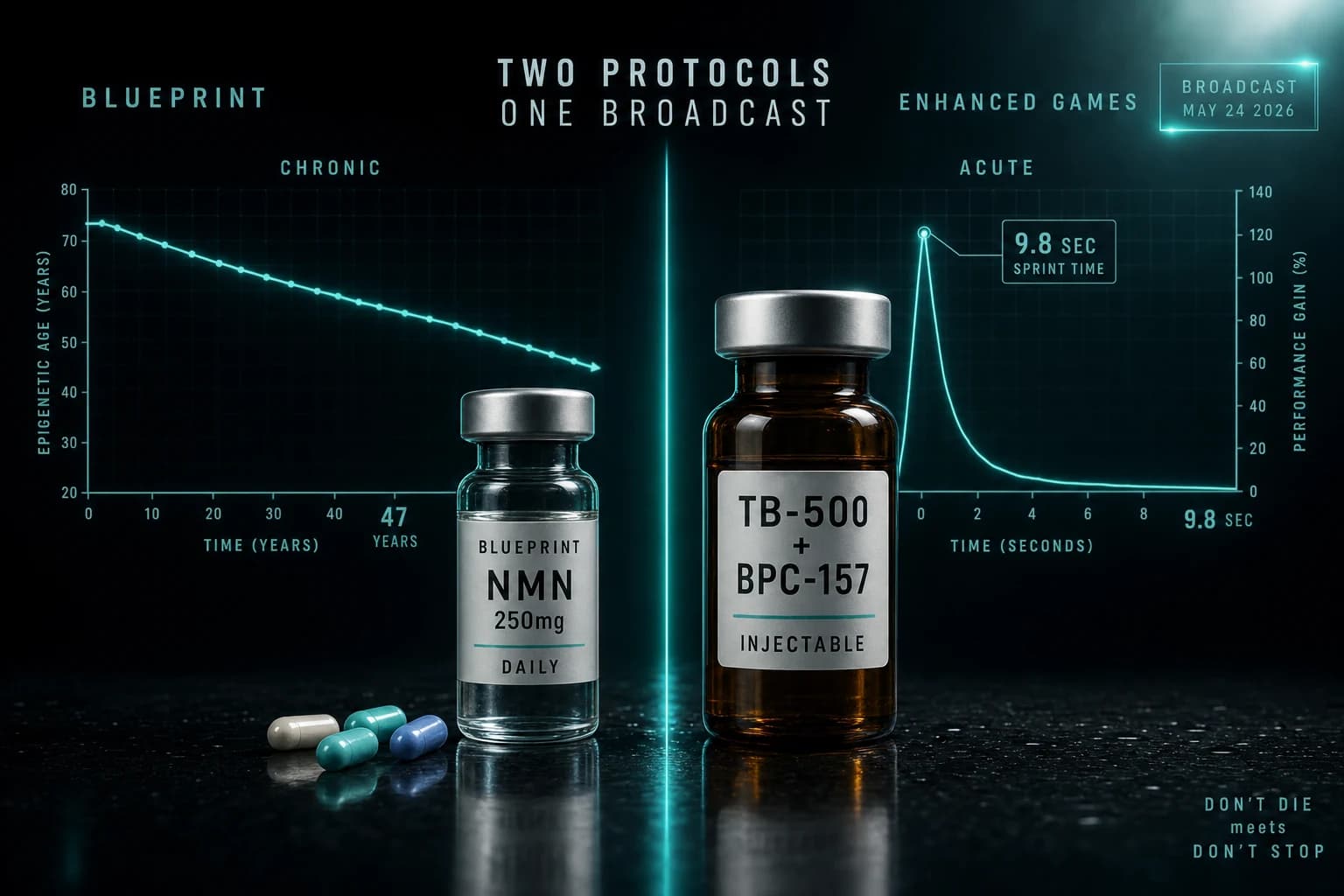
Bottom line: The Enhanced Games' chosen science explainer optimizes for biological-age reduction across decades. The athletes he was explaining optimize for a 9-second window. Same broadcast, two completely different theories of "enhancement."
What Bryan Johnson actually does in Blueprint
Johnson has the most documented self-experimentation protocol in modern longevity. His current state as of early 2026, based on his public disclosures and the recently consolidated Blueprint stack:
The supplement load. 40+ oral supplements daily, split across breakfast, dinner, and a pre-exercise block six days a week. Core items include NMN (now six days per week, down from daily), metformin, low-dose lithium, NDGA (a newer 2026 addition for brain protection), vitamin D, omega-3, creatine, CoQ10, lycopene, astaxanthin, glucosamine, and 20 to 30 grams of collagen peptides per day.
What he dropped. Rapamycin was removed from the stack in 2025 due to side effects. TRT (Androderm patches at 58.2 mg per week) was discontinued after he restored testosterone to ~704 ng/dL naturally by easing his caloric restriction from 25% to about 10%.
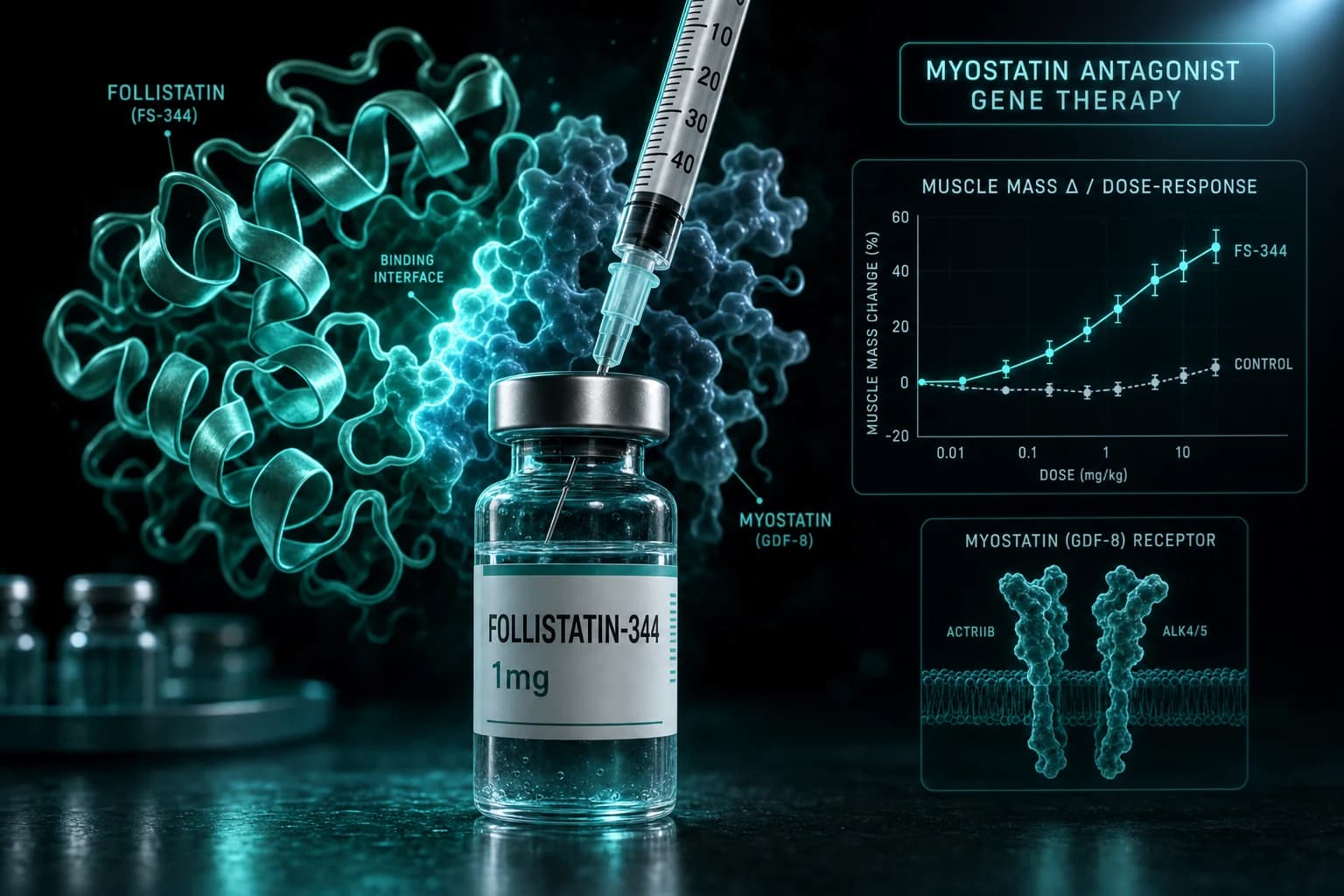
What he never publicly stacked. The high-profile injectable performance peptides (BPC-157, TB-500, CJC-1295, Ipamorelin) are not in Johnson's published consumer stack. He has openly experimented with Cerebrolysin (off-label nootropic) and Follistatin gene therapy (one-off trial), and his Blueprint Peptide Serum contains a topical biomimetic blend including EGF, Thymosin-β4, SCF, hGH analogues, VEGF, PDGF, Follistatin, and Copper Tripeptide-1. The distinction matters: oral and topical peptides are bioavailability-limited and effect-limited, which is why he uses them in those forms. Injectable performance peptides are what Enhanced Games athletes actually run.
What he eats. A vegan, ultra-low-glycemic diet at 2,250 kcal/day, roughly 10% caloric restriction. The CALERIE 2-year RCT in healthy non-obese adults established that 10 to 12% sustained caloric restriction produces measurable improvements in cardiometabolic markers and slows phenotypic biological aging (Ravussin et al. (2015)). Johnson's protocol is more aggressive in execution than CALERIE's average compliance, which sat closer to 11.7%.
The reported result. Johnson's published biomarkers consistently track an epigenetic age below his chronological age (47). His own caveats apply: he is a sample of one, his testing cadence is self-managed, and the absence of a control group is the same one he applies to athletes.
What Enhanced Games athletes are actually running
We covered the disclosed stacks in earlier pieces. The disclosed examples follow a different shape entirely:
James Magnussen, the Australian swimmer competing for the $1 million 50m freestyle world-record bonus, disclosed his pre-event stack: supraphysiological testosterone, BPC-157 (injectable), TB-500 (injectable), CJC-1295, Ipamorelin, and Thymosin α-1. Our full breakdown is in the Magnussen Wolverine Stack article.
The general Enhanced Games protocol pattern (covered in our Enhanced Games 2026 peptides & PEDs primer): testosterone or testosterone analogues at supraphysiological doses, peptide growth-hormone secretagogues (CJC-1295 + Ipamorelin or Sermorelin), recovery peptides (BPC-157, TB-500), immune peptides (Thymosin α-1), and occasional erythropoiesis-stimulating agents.
The two protocols look almost nothing alike. Bryan Johnson's stack is biased toward chronic, sub-physiological perturbation aimed at reducing all-cause mortality risk. Enhanced Games stacks are biased toward acute, supraphysiological perturbation aimed at the next race.
| Dimension | Bryan Johnson (Blueprint) | Magnussen-type EG athlete |
|---|---|---|
| Time horizon | Decades | One competition window |
| Testosterone | ~700 ng/dL natural, no TRT | Supraphysiological, exogenous |
| Caloric balance | ~10% restriction | Surplus during peak |
| Injectable peptides | None disclosed | BPC-157, TB-500, CJC-1295, Ipamorelin |
| GH axis | Sleep + creatine + recovery | CJC-1295 / Ipamorelin pulses |
| Recovery target | Sustained low inflammation | Acute tissue turnover |
| Primary endpoint | Epigenetic age, biomarker panel | Race time |
Where the two protocols actually converge
The convergence is small but worth naming because it is where Johnson's commentary likely landed:
The thymosin family. Magnussen injects TB-500 (Thymosin β-4 synthetic analog) for tissue repair. Johnson's Blueprint topical peptide serum contains Thymosin-β4. Same molecule family, very different delivery. The systemic effects of injectable TB-500 in humans are not well-characterized in RCTs; the strongest published mechanism work is preclinical, including BPC-157's accelerated Achilles tendon-to-bone healing in rats (Krivic et al. (2006)). Topical peptide application enters a different bioavailability bucket entirely.
Collagen and connective tissue. Both stacks heavily prioritize collagen. Johnson at 20 to 30 grams oral per day; athletes via injectable healing peptides on top of oral collagen.
Creatine and basic recovery basics. Both Blueprint and Enhanced Games athlete protocols include creatine, omega-3, and protocols designed around sleep architecture. The boring stuff is identical.
Biomarker tracking. Both groups test compulsively. Johnson publishes his panels; Enhanced Games athletes are required to disclose theirs under the Games' IRB-monitored protocols.
Bottom line: The honest overlap is "track everything, sleep enough, take creatine, eat your collagen." The divergence is everything beyond that.
What the broadcast actually showcased
Johnson's pre-event framing, posted to X on the eve of the broadcast: "I'm cohosting the Enhanced Games this Sunday, first time as a broadcaster. It's the Olympics with enhancement allowed. Athletes use FDA-approved medications prescribed and supervised by doctors."
That framing is the central piece. Note what it asserts:
- The athletes' protocols are physician-supervised
- The medications are FDA-approved (in their indicated uses, even if used off-label here)
- Most protocols were monitored under IRB clinical trials in the year leading up to the Games
This is the legitimacy theater the Games has spent two years building. Replacing the WADA prohibited list with physician oversight and IRB documentation is the entire bet. Johnson's selection as the science explainer is consistent with that bet: he is the most public face of long-horizon protocolized self-experimentation outside elite sport.
What this is not: a randomized trial. Athletes self-select into Enhanced Games. Their stacks are clinician-prescribed but not standardized across competitors. The IRB documentation establishes informed consent and adverse-event tracking, not efficacy comparison. As a research signal, the Games is a registry, not an experiment.
Why the NAD axis matters in the contrast
The single largest area of overlap between longevity research and athletic enhancement research is NAD+ biology. Both populations care about it for different reasons.
Johnson's case. He runs NMN at 250 to 500 mg six days a week. The strongest published clinical signal for that dose comes from a 12-week placebo-controlled trial in healthy older men: 250 mg NMN daily significantly raised whole-blood NAD+ levels and produced nominally significant improvements in gait speed and grip strength (Igarashi et al. (2022)). The effect size is modest. The safety profile in published trials at these doses has been clean.
Athletes' case. NAD precursors and IV NAD+ have crossed into the recovery and mitochondrial-function lane. Several Enhanced Games athletes have disclosed NAD+ as part of their pre-event protocol. Mechanism overlaps with Johnson's stack; the dosing scale and route do not.
For the deeper view, our NAD+ injection protocol article and the NAD+ compound guide cover the clinical state in more detail. Johnson's commentary in the broadcast leaned heavily on the NAD biology framing for the swim and sprint events where mitochondrial demand peaks.
What this all signals about peptide mainstreaming
The thing the Bryan Johnson booking actually moves is not the science. It is the audience overlap.
Johnson's Don't Die audience is millions of crossover viewers who care about biological-age reduction but have never opened the WADA prohibited list. Putting him on the Enhanced Games broadcast hands that audience the language for compounds they would otherwise have dismissed as "doping." Whether or not any individual viewer ever uses BPC-157 or supraphysiological testosterone, the framing shifts from "drug cheats" to "supervised enhancement protocol."
This is the same trajectory we have tracked across the GLP-1 class, the GH-secretagogue class, and the recovery-peptide class. Compounds move from gray-market research-vial to telehealth-prescribed (see the Yucca Health review for the GLP-1 version) to mainstream when (a) a high-profile non-athlete adopts them and (b) the legal framing moves from prohibition to clinician oversight. The Enhanced Games broadcast checked both boxes simultaneously.
For the deeper longitudinal coverage, see the Enhanced Games opening-day stacks and stakes article and the FDA peptide reclassification February 2026 breakdown. The two pieces together explain the policy substrate that made this broadcast possible.
FAQ
Does Bryan Johnson use BPC-157 or TB-500?
Not in his publicly disclosed Blueprint consumer stack. He has experimented with injectable peptides including Cerebrolysin and Follistatin gene therapy, but BPC-157 and TB-500 in their injectable form are not in his published daily protocol. His Blueprint Peptide Serum (topical) does contain Thymosin-β4 in the same family as TB-500.
Is Bryan Johnson on TRT?
No, currently. He used Androderm testosterone patches at 58.2 mg per week to offset hormonal suppression from severe caloric restriction. After easing the caloric restriction from 25% to about 10%, he discontinued TRT and reports natural testosterone of approximately 704 ng/dL.
How much does Blueprint cost?
The core public-facing stack (Longevity Mix, Essential Capsules, Omega-3, Collagen Peptides, Extra Virgin Olive Oil) is available direct from Blueprint at a tier that runs a few hundred dollars per month for the full bundle. Johnson's personal protocol includes prescription medications, gene therapies, and one-off trials that are not part of the consumer product.
Did Bryan Johnson criticize the Enhanced Games athletes' protocols on air?
Pre-broadcast, Johnson framed the Games as physician-supervised and IRB-monitored, not as reckless. His public framing has been pro-enhancement-with-oversight. Whether his on-air analysis varied by athlete or compound class is something post-broadcast clips will determine; pre-event statements suggest a translation-not-critique posture.
Why is BPC-157 in athlete stacks but not in Johnson's?
BPC-157 is favored for acute tissue-recovery windows, particularly post-injury or peri-competition. Johnson's protocol does not need that acute window because he is not training for an event. The injectable route also carries higher regulatory and quality-control overhead than oral or topical alternatives, which Johnson tends to avoid in his consumer-grade stack.
How does Johnson's stack compare to the GLP-1 class?
He does not take GLP-1 medications. His weight management is achieved through caloric restriction and protocolized exercise. For the GLP-1 side of the metabolic-enhancement conversation, see our retatrutide TRIUMPH-1 article and the Yucca Health prescription path review.
Is the Enhanced Games actually testing anything scientifically?
Operationally, no. The Games provide informed consent, physician oversight, and adverse-event tracking, which create a registry but not a randomized comparison. Athletes self-select into the format and use clinician-individualized protocols rather than standardized arms. The IRB documentation is real and clinically meaningful; the efficacy comparison across athletes is not.
Will Bryan Johnson come back for the next Enhanced Games?
Unconfirmed. The inaugural broadcast was his first time as a broadcaster. The format played to his strengths (translating compounds into plain language for a non-clinical audience) and the audience overlap is large, so a return engagement is the obvious next step.
Further reading
- Enhanced Games 2026 peptides & PEDs primer
- Enhanced Games May 24 2026 opening-day stacks and stakes
- James Magnussen's Enhanced Games disclosed Wolverine Stack
- Wolverine Stack BPC-157 + TB-500 recovery protocol
- FIT Stack CJC-1295 + Ipamorelin GH protocol
- NAD+ injection protocol evidence
- FDA peptide reclassification February 2026 breakdown
- Yucca Health review 2026 (prescription GLP-1 path)
- Ascension Peptides review 2026 (research-grade vials)
Source the same recovery peptides at Ascension: 50% off with code ENHANCED
The peptides athletes actually inject at the Enhanced Games (BPC-157, TB-500, CJC-1295, Ipamorelin, Thymosin α-1) are available as research-grade vials with public per-batch COAs at our partner Ascension Peptides. Code ENHANCED takes 50% off the entire catalog. Pre-mixed options that match athlete stacks include the Wolverine Stack (BPC-157 + TB-500) and the FIT Stack (CJC-1295 + Ipamorelin).
For the broader vendor evaluation, see the Ascension Peptides review 2026 and the best legit peptide vendors 2026 ranking.
This article is for educational and informational purposes only. Bryan Johnson's published Blueprint protocol is summarized from his public disclosures and Netflix documentary. Enhanced Games athlete protocols are summarized from publicly disclosed pre-event interviews. None of the content above constitutes a recommendation to use testosterone, peptides, or any performance-enhancing substance. Long-term safety of supraphysiological testosterone, injectable peptide combinations, and many longevity-protocol compounds is not fully characterized in published literature. Research-grade peptides are sold for laboratory research use only and are not approved for human consumption. Consult a qualified clinician before considering any peptide or hormone protocol.