At a glance
- Magnussen publicly disclosed five compounds for his Enhanced Games preparation: testosterone, BPC-157, CJC-1295, Ipamorelin, and Thymosin
- Testosterone is the foundational anabolic, described by Magnussen as 'the superpower' that drives recovery, strength, and morning energy
- BPC-157 + Thymosin combo is the recovery and injury-prevention layer; CJC-1295 + Ipamorelin is the GH-pulse layer for body composition and recovery
- The protocol is medically supervised with weekly blood-marker monitoring; Magnussen has emphasized the safety framing in every public statement
- Swimming-specific advantage: the recovery peptides target the high-volume training load characteristic of elite freestyle preparation
James Magnussen is the rare athlete who has gone fully public about his pre-event protocol. The Australian Olympic swimming medalist disclosed his five-compound Enhanced Games stack in detail: testosterone as the foundation, BPC-157 and Thymosin for recovery, CJC-1295 and Ipamorelin for the GH-pulse layer. He's said repeatedly that everything is medically supervised with weekly blood-marker checks. With the Enhanced Games opening tomorrow at Resorts World Las Vegas (May 21-24), Magnussen's stack is the cleanest public window into what elite athletes are actually using when they don't have to hide it.
This article walks through each compound in his disclosed protocol, the mechanism case for the swimming-specific applications, and the published research that supports (and limits) each piece.
What Magnussen disclosed
In a series of interviews leading up to the Enhanced Games, Magnussen named five compounds in his protocol:
| Compound | Role in protocol | Format |
|---|---|---|
| Testosterone | Foundational anabolic | Injectable, weekly |
| BPC-157 | Tissue repair + injury prevention | Injectable, daily |
| Thymosin (TB-500 / Thymosin α-1) | Recovery + immune support | Injectable, weekly |
| CJC-1295 | GHRH analog, GH production | Injectable, daily |
| Ipamorelin | GHRP, GH release pulses | Injectable, daily |
He described testosterone as "the superpower," the compound he credited with the bounding-out-of-bed feeling, the heavy lifts, and the sustained training capacity. The peptides were positioned as the supporting layer: recovery and injury prevention from BPC-157 + Thymosin, GH-pulse support from CJC-1295 + Ipamorelin.
The most-quoted line from Magnussen: "It all felt safe because I did it all with doctors and under medical supervision." Weekly check-ups, full blood-marker panels, dose adjustments based on labs. The Enhanced Games framing has been consistently medical-supervision-forward, and Magnussen has been the cleanest voice for that narrative.
For the broader Enhanced Games context including event format and the regulatory backdrop, see the Enhanced Games May 24 opening-day article and the original Enhanced Games 2026 peptides primer.
The testosterone foundation
Testosterone is the structural compound of the stack. Magnussen's specific dose hasn't been published, but the descriptions are consistent with the supraphysiological range used in disclosed athlete protocols: 250-500 mg per week, injectable testosterone enanthate or cypionate.
The mechanism is well-established in the published literature. Testosterone drives muscle protein synthesis, supports recovery between training sessions, increases red blood cell production (relevant for endurance), and raises baseline aggression and training capacity. The body composition effects are direct: more lean mass, lower body fat at matched caloric intake.
For Olympic-level swimming preparation, the relevant testosterone benefits are:
- Recovery between training sessions. Elite swimmers train 6-10 sessions per week. Supraphysiological testosterone shortens recovery time meaningfully.
- Lean mass maintenance during high-volume training. High-volume aerobic training tends to suppress muscle protein synthesis. Testosterone counteracts this.
- Sustained training capacity over a cycle. The 6-12 month pre-event preparation window benefits from sustained anabolic support.
The peptide layer of the stack is meaningful but secondary to testosterone's contribution. Magnussen's framing of testosterone as "the superpower" is consistent with what the protocol literature suggests.
BPC-157 + Thymosin: the recovery layer
The recovery peptides in Magnussen's stack target tissue repair and injury prevention through complementary mechanisms.
BPC-157 is a synthetic 15-amino-acid peptide derived from a sequence in human gastric juice. The published animal evidence covers tendon healing, ligament repair, gut mucosal protection, and angiogenesis. Standard research-grade dosing is 250-500 mcg daily subcutaneous, with cycles often run 4-8 weeks.
Thymosin (TB-500 or Thymosin α-1). When athletes say "thymosin" in this context, they usually mean TB-500, the synthetic 17-amino-acid fragment of Thymosin β4 that drives cell migration and tissue repair systemically. Some protocols also include Thymosin α-1, a different peptide entirely (28 amino acids) used for immune modulation. Magnussen hasn't clarified which thymosin specifically, but the recovery context suggests TB-500.
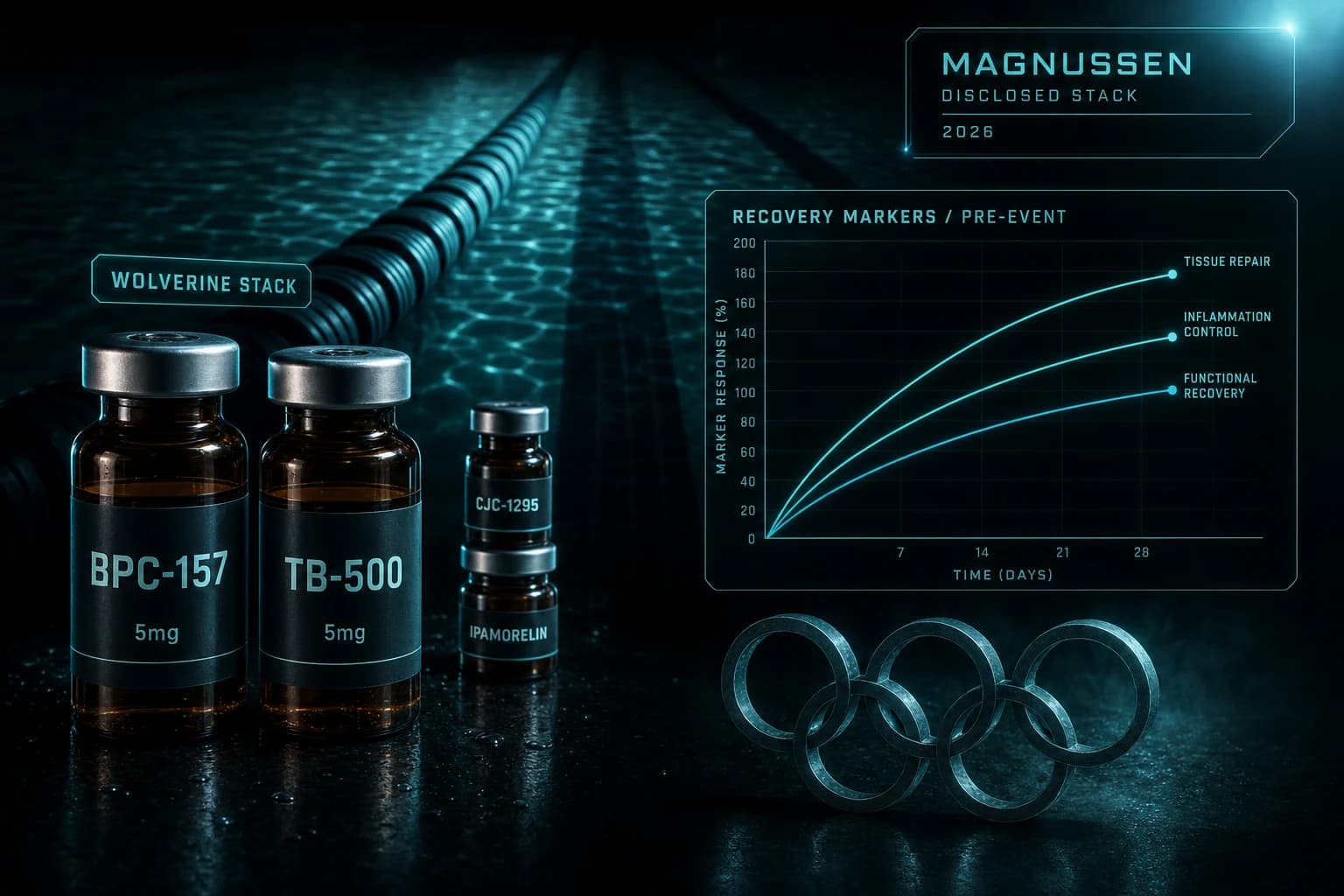
The combination is essentially the Wolverine Stack: BPC-157 + TB-500 in pre-mixed injectable format. The mechanistic case:
- BPC-157 drives local angiogenesis and growth factor expression at injury sites
- TB-500 drives systemic cell migration and prepares the whole body for repair
- Combined, they cover both the local-site repair signaling and the systemic recovery infrastructure
For a swimmer training 30,000+ meters per week, the relevant micro-injuries are rotator cuff strain, hamstring fatigue, lower back inflammation, and shoulder labrum stress. The Wolverine combination is mechanistically aimed at exactly this profile.
For the deeper compound research, see the BPC-157 dosing protocol guide, the TB-500 dosage guide, and the Wolverine Stack recovery protocol.
Bottom line: The recovery peptide layer is the most-replicated portion of Magnussen's stack across other Enhanced Games swimmers. BPC-157 + TB-500 is essentially a standard component of elite athletic peptide protocols at this point.
CJC-1295 + Ipamorelin: the GH-pulse layer
The growth hormone secretagogue pair in Magnussen's stack targets endogenous GH release without injecting exogenous GH.
CJC-1295 is a modified GHRH (1-29) analog that stimulates pituitary GH production through the GHRH receptor. The no-DAC version (CJC-1295 without Drug Affinity Complex) has a 30-minute half-life and supports natural pulsatile GH release. Standard research-grade dosing is 100 mcg 1-3 times daily subcutaneous.
Ipamorelin is a synthetic pentapeptide GHRP that activates the GHSR-1a (ghrelin receptor) to trigger acute GH release. Unlike older GHRPs (Hexarelin, GHRP-2, GHRP-6), Ipamorelin produces minimal cortisol and prolactin elevation, making it the cleanest GHRP for chronic athletic protocols.
Combined, they amplify each other through two different receptor systems. The classic stack format is 100 mcg of each, three times daily, subcutaneous. This is the FIT Stack configuration.
For Olympic-level swimming, the GH-pulse layer contributes:
- Body composition shift. GH pulses drive lipolysis and modest lean mass support beyond what testosterone alone provides
- Sleep quality. GHRP-mediated pulses time-shifted to nighttime support deep sleep, which underlies endurance recovery
- Joint and connective tissue support. GH-mediated IGF-1 release supports connective tissue maintenance
The trade-off versus injecting exogenous human growth hormone (HGH) is that the secretagogue pair produces smaller GH pulses than direct GH injection. The benefit is a cleaner safety profile and a more physiological pulse pattern. Magnussen's framing of medical supervision aligns with the choice of secretagogues over direct GH.
For the deeper protocol coverage, see the FIT Stack CJC-1295 + Ipamorelin protocol and the Sermorelin vs CJC-1295 vs Ipamorelin comparison.
What's NOT in Magnussen's disclosed stack
For completeness, several compounds that often appear in elite athletic protocols are NOT in Magnussen's public disclosure:
- Direct HGH (somatropin) injection. Magnussen uses the secretagogue pair instead
- IGF-1 LR3. Direct IGF-1 receptor activation; not in the disclosure
- EPO (erythropoietin). Endurance-specific; not in the swimming-focused stack
- Stimulants. Pre-event neural drive; not in the chronic protocol disclosure
- Aromatase inhibitors. Usually accompanies testosterone but Magnussen hasn't named one publicly
The absence doesn't mean these aren't used. It means they aren't part of the publicly-disclosed core stack. The Enhanced Games framework asks athletes to use FDA-approved substances under medical supervision; specific compound choices vary by athlete and event.
How Magnussen's stack relates to the rest of the field
Other Enhanced Games athletes have disclosed broadly similar stacks. Across the disclosed protocols:
| Compound | Magnussen | Other disclosed swimmers | Sprint athletes (e.g. Kerley) |
|---|---|---|---|
| Testosterone | ✓ | Common | Common |
| BPC-157 | ✓ | Common | Less common |
| TB-500 | ✓ (as Thymosin) | Common | Less common |
| CJC-1295 + Ipamorelin | ✓ | Common | Common |
| Direct HGH | not disclosed | Variable | More common |
| Stimulants | not in chronic stack | rare | Pre-event, common |
The swimming-class athletes lean heavier on the recovery peptide layer because of the high training volume. The sprint-class athletes lean heavier on neural drive and explosive power compounds.
For the broader Enhanced Games athlete-protocol context across swimming and sprint events, see the Enhanced Games May 24 opening-day article.
The medical supervision framing
Magnussen has been consistent on one point: the protocol is built around medical supervision, not gray-market dosing. The published interviews emphasize:
- Weekly blood-marker panels (CBC, comprehensive metabolic, lipid, hormone)
- Dose adjustments based on labs
- Physician oversight on all compounds
- Stop-criteria documented in advance
This framing is the Enhanced Games' core regulatory argument. The compounds Magnussen disclosed are all either FDA-approved (testosterone, in TRT contexts) or accessible through US compounding pharmacies following the February 27, 2026 HHS reclassification (BPC-157, CJC-1295, Ipamorelin moved back to Category 1). The regulatory positioning has moved meaningfully in Magnussen's favor over the 12 months of pre-event preparation.
For the regulatory context, see the FDA peptide reclassification complete breakdown.
What to watch on opening day
Magnussen competes in the men's 100m freestyle on May 23. The performance question the Enhanced Games is designed to answer: does the disclosed stack produce times meaningfully faster than what Magnussen ran under WADA-tested conditions?
His WADA-era personal best is 47.10 (2012 Olympic 100m freestyle silver). The Enhanced Games target is reportedly under 46.50. That 0.60-second margin is the data point the protocol is engineered to produce. If he hits it, the stack gets validated empirically. If he doesn't, the protocol case gets weaker.
The same logic applies across the Enhanced Games athletics events. Performance ceiling is the central measurable; everything else is supporting narrative.
FAQ
What is James Magnussen's full Enhanced Games stack?
Five compounds disclosed publicly: testosterone (the foundational anabolic), BPC-157 (tissue repair), Thymosin (which in his recovery context is typically TB-500, sometimes Thymosin α-1), CJC-1295 (GHRH analog), and Ipamorelin (GHRP). The protocol is medically supervised with weekly blood-marker monitoring.
Is Magnussen taking HGH?
Not directly. His disclosed protocol uses CJC-1295 + Ipamorelin to drive endogenous GH pulses through the pituitary, rather than injecting exogenous human growth hormone. The trade-off is smaller GH pulses than direct HGH but a cleaner safety profile.
What does "Thymosin" mean in his stack?
Ambiguous. Athletes often say "Thymosin" to refer to either TB-500 (Thymosin β4 fragment, used for tissue repair) or Thymosin α-1 (28-amino-acid peptide for immune modulation). The recovery context in Magnussen's stack suggests TB-500, but he hasn't specified publicly.
Is the Wolverine Stack legal in the US?
The compounds (BPC-157, TB-500) moved back to FDA Category 1 in the February 27, 2026 HHS reclassification, restoring legal compounding-pharmacy access with a clinician prescription. Research-grade retail access through peptide vendors operates under separate research-use disclosures.
How is Magnussen's protocol different from other swimmers?
Most disclosed Enhanced Games swimmer stacks include the same core: testosterone + BPC-157 + TB-500 + CJC-1295 + Ipamorelin. Variations are in specific doses, pre-event stimulant additions, and whether direct HGH replaces or supplements the secretagogue pair. Magnussen's protocol sits in the cleaner end of the disclosed spectrum.
Does Magnussen's protocol violate WADA rules?
Yes. Several compounds in the disclosure (BPC-157, TB-500, CJC-1295, Ipamorelin, testosterone above physiological levels) are on the WADA prohibited list. Magnussen is no longer competing in WADA-tested events; the Enhanced Games operates outside the WADA framework.
When does Magnussen compete?
Men's 100m freestyle final on May 23, 2026 at Resorts World Las Vegas. Memorial Day Weekend Enhanced Games run May 21-24.
Further reading
- Enhanced Games May 24 2026 opening-day stacks and stakes
- Enhanced Games 2026 peptides & PEDs primer
- Wolverine Stack BPC-157 + TB-500 recovery protocol
- FIT Stack CJC-1295 + Ipamorelin GH protocol
- BPC-157 dosing protocol guide
- TB-500 dosage guide
- Sermorelin vs CJC-1295 vs Ipamorelin comparison
- Thymosin alpha-1 + BPC-157 combined immune recovery protocol
- FDA peptide reclassification February 2026 complete breakdown
- Best legit peptide vendors 2026
Shop the Magnussen stack: 50% off with code ENHANCED
For research-grade injectable BPC-157, TB-500, CJC-1295, Ipamorelin, and Thymosin α-1, our partner Ascension Peptides ships with public per-batch COAs. Code ENHANCED takes 50% off the entire catalog.
Pre-mixed convenience: the Wolverine Stack covers BPC-157 + TB-500 in one vial. The FIT Stack covers CJC-1295 + Ipamorelin.
Testosterone is not a research peptide and is not sold through peptide vendors. It is prescription-only and requires a clinician relationship for any legitimate access.
For the deeper vendor evaluation, see the Ascension Peptides review 2026 and the best legit peptide vendors 2026 ranking.
This article is for educational and informational purposes only. James Magnussen's protocol is summarized based on his public interview disclosures and published reporting. None of the content above constitutes a recommendation to use testosterone, peptides, or any performance-enhancing substance. Long-term safety of supraphysiological testosterone and peptide combinations is not fully characterized in published literature. Athletes considering similar protocols should consult qualified clinicians and understand that WADA-tested competition prohibits most of these compounds.