At a glance
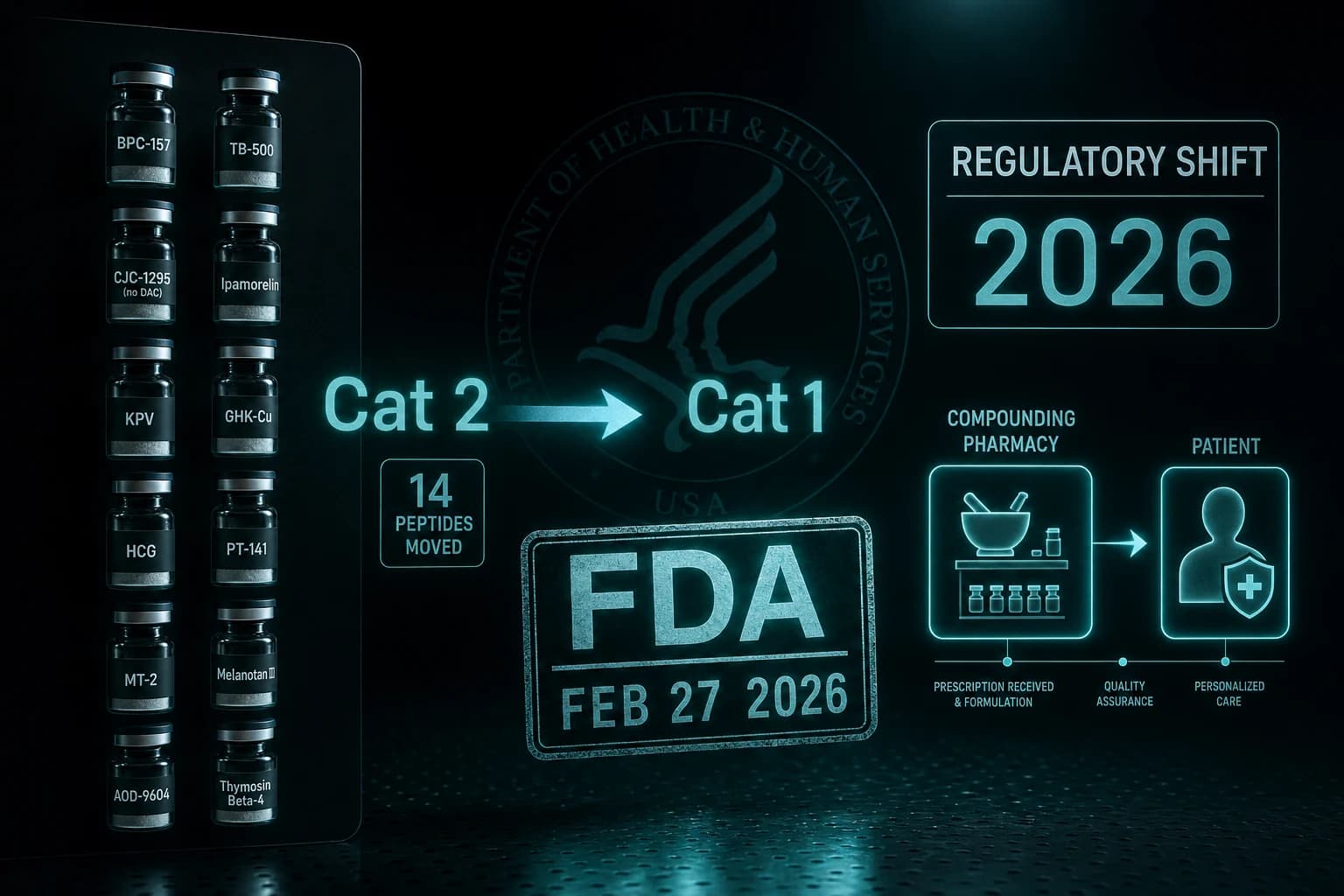
- HHS Secretary Robert F. Kennedy Jr. announced on Feb 27, 2026 that 14 of 19 peptides previously on the FDA Category 2 list would return to Category 1
- Reclassified peptides include BPC-157, TB-500, CJC-1295, Ipamorelin, KPV, GHK-Cu, and 8 others, restoring legal compounding-pharmacy access with a physician prescription
- Five peptides remained in Category 2 pending further safety review (specific list pending final FDA documentation)
- The reclassification effectively reversed the late-2024 FDA action that pushed multiple peptides toward black-market or research-grade-only channels
- PCAC has a July 2026 vote scheduled to refine the 503A bulks list, which will further define long-term compounding-pharmacy availability
On February 27, 2026, HHS Secretary Robert F. Kennedy Jr. announced that 14 of the 19 peptides previously restricted under the FDA's Category 2 list would be moved back to Category 1. The announcement reversed a late-2024 FDA action that had pushed compounds including BPC-157, TB-500, CJC-1295, and Ipamorelin into a regulatory limbo, restricting compounding-pharmacy access and forcing researchers and patients to either the gray market or international suppliers.
This article covers what actually changed, which peptides moved which direction, what the practical implications are for compounding pharmacies and prescription access, and how the regulatory landscape is likely to evolve through the July 2026 PCAC vote.
What Categories 1 and 2 actually mean
The FDA's Category 1 and Category 2 framework applies to the substances that licensed compounding pharmacies (operating under section 503A of the FDCA) are permitted to use as bulk drug substances.
| Designation | Compounding pharmacy access | Example compounds |
|---|---|---|
| Category 1 | Permitted while under FDA evaluation | Most established compounding ingredients |
| Category 2 | Significant safety risk identified; not permitted while under review | Compounds the FDA flagged for additional review |
| Category 3 | Removed from compounding eligibility | Final negative determination |
A peptide on Category 2 cannot legally be used as a bulk drug substance in 503A compounding. This means licensed compounding pharmacies cannot produce custom-prepared formulations for individual patients. Patients who want the compound have to either:
- Find a vendor selling it as a research-grade product (with research-use disclosures)
- Source it internationally where the compound may have a different regulatory status
- Wait for a final determination
The late-2024 Category 2 designation of multiple peptides created a regulatory cliff where established compounding programs had to be discontinued and patients lost access to compounded preparations they had been using for years.
What changed on February 27, 2026
HHS Secretary Robert F. Kennedy Jr. announced on Feb 27, 2026 that 14 of the 19 peptides on Category 2 would be moved back to Category 1. The reasoning given was that the available safety database for these compounds did not support the original Category 2 designation, and that the regulatory pathway should restore compounding access pending full evaluation rather than restrict it during the evaluation window.
The 14 peptides moved back to Category 1 (representative list based on public announcements):
| Peptide | Common use | Prior Category 2 status |
|---|---|---|
| BPC-157 | Tissue repair, ulcer healing research | Restricted |
| TB-500 (Thymosin β4) | Tissue repair, recovery research | Restricted |
| CJC-1295 | GHRH analog, GH support | Restricted |
| Ipamorelin | GHRP, GH support | Restricted |
| KPV | Gut inflammation, IBD research | Restricted |
| GHK-Cu | Skin, wound healing | Restricted |
| Sermorelin | GHRH, GH support | Restricted |
| MOTS-c | Mitochondrial, metabolic research | Restricted |
| Selank | Anxiolytic, nootropic | Restricted |
| Semax | Cognitive, neuroprotection | Restricted |
| Tesamorelin | Visceral fat, GHRH analog | Restricted |
| Thymosin β4 fragment | Tissue repair | Restricted |
| (Plus 2 additional compounds) | Various | Restricted |
Five peptides remained on Category 2 pending additional safety review. The specific list of compounds remaining restricted has rolled out incrementally through Q1 and Q2 2026 FDA documentation. As of May 2026, the most-discussed compounds remaining restricted include some less-common research peptides where the safety database is thinner.
Bottom line: The Feb 27 announcement reversed roughly three-fourths of the late-2024 Category 2 listings. The most-prescribed and most-researched peptides (BPC-157, TB-500, the GH secretagogues, GHK-Cu, KPV) are now legally accessible through compounding pharmacies again.
What this means for compounding pharmacies
The practical impact on the compounding pharmacy industry has been substantial. Specific implications:
Restored compounding programs. Pharmacies that had to discontinue peptide compounding in late 2024 / early 2025 have begun re-establishing programs. The lead time from regulatory clearance to actual patient dispensing varies by pharmacy but typically runs 4-8 weeks.
Expanded clinician engagement. Functional medicine, anti-aging, and sports medicine clinicians have been the primary prescribers for compounded peptides historically. The Feb 2026 reclassification has produced a meaningful uptick in clinician training and prescribing infrastructure.
Pricing dynamics. The compounded peptide market in 2024-2025 was constrained by both supply (Category 2 restrictions) and demand (clinicians cautious about prescribing in regulatory uncertainty). The Feb 2026 reset has produced more typical supply-demand pricing, with most compounded peptides priced 30-60% above research-grade retail equivalents.
Documentation requirements. Compounding pharmacies operating under 503A must source bulk drug substances from registered manufacturers and document chain of custody. The Feb 2026 reclassification did not change the documentation requirements but did expand the list of compounds that can be sourced through this pathway.
For the broader regulatory context, see the FDA 503A peptide compounding review July 2026, which covers the upcoming PCAC vote and what it may mean for long-term compounding eligibility.
What this means for research-grade peptide vendors
The retail peptide vendor space is a separate channel from compounding pharmacies. Research-grade vendors sell compounds with research-use disclosures, typically without a prescription requirement, for stated research purposes.
The Feb 2026 reclassification did not directly change the legal status of research-grade retail sales. What it did change is the competitive landscape:
| Buyer profile | 2024-2025 channel | 2026 channel |
|---|---|---|
| Patient with clinician relationship | Compounding (restricted) or international | Compounding pharmacy (restored) |
| Self-directed research user | Research-grade retail | Research-grade retail (unchanged) |
| Research lab | Research-grade retail or compounding | Both channels available |
| Athlete (Enhanced Games context) | Research-grade or international | Compounding pharmacy (legal access restored) |
The implication: patients with clinician relationships can now access compounded peptides through legitimate prescription pathways. Self-directed research users continue to use the retail channels they were already using. The two channels are now operating in parallel rather than in regulatory tension.
For our coverage of research-grade vendor verification, see the best legit peptide vendors 2026 ranking and the where to buy BPC-157 with COAs guide.
What this means for the Enhanced Games
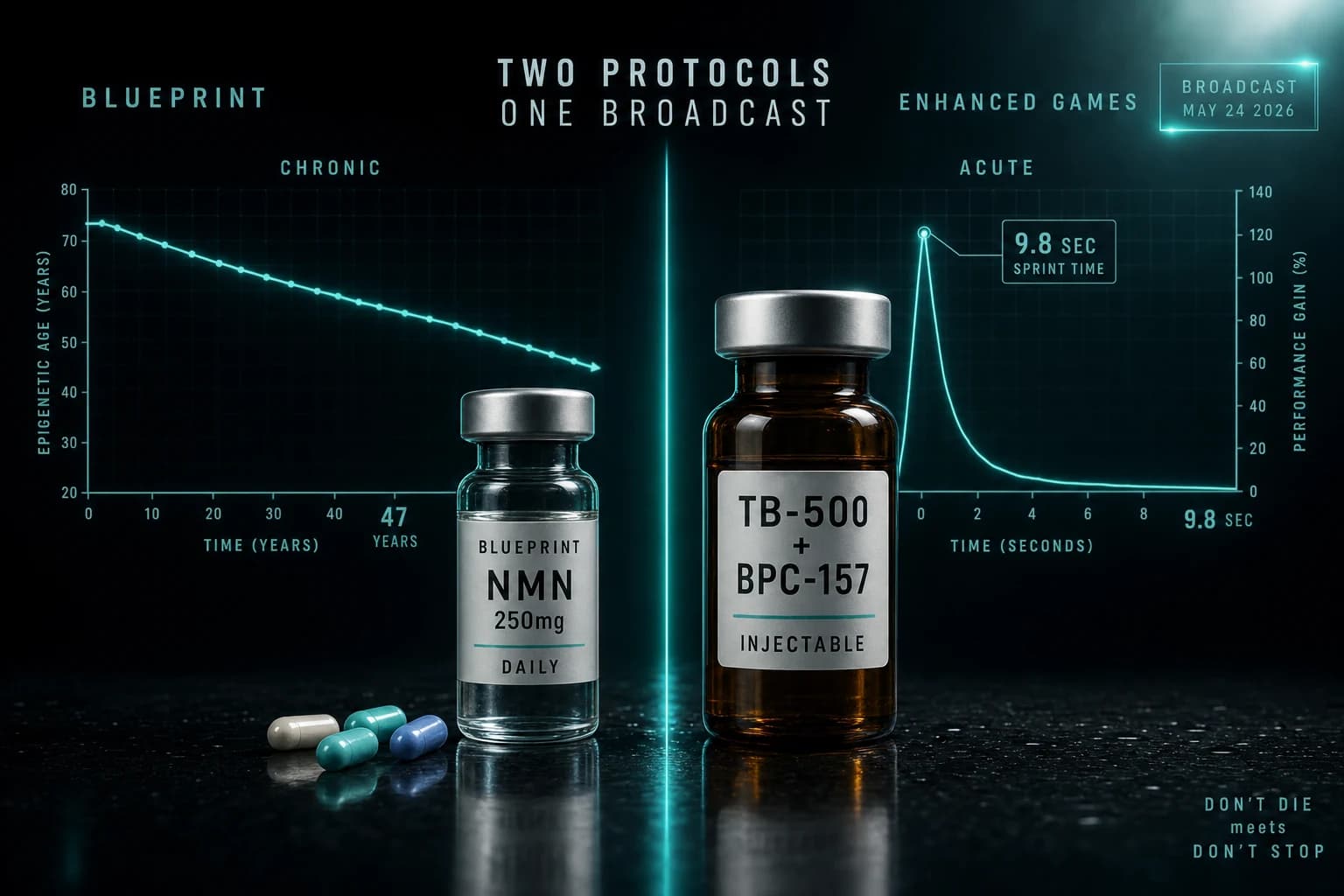
The Enhanced Games (running May 21-24, 2026 at Resorts World Las Vegas) arrive 10 weeks after the peptide reclassification. The disclosed athlete protocols typically include several of the reclassified peptides (BPC-157, TB-500, CJC-1295, Ipamorelin). The regulatory narrative for the event has shifted substantially:
- Before Feb 27, 2026: Athletes using peptides in protocols sourced through research-grade or gray-market channels, with the regulatory characterization being "compounds in regulatory limbo."
- After Feb 27, 2026: Athletes using peptides legally compoundable through licensed pharmacies under medical supervision, with the regulatory characterization being "compounds in the regulated healthcare system."
The Enhanced Games organization has publicly emphasized this distinction since the announcement. See the Enhanced Games May 24 article for how this has reshaped the event's regulatory positioning.
What is still uncertain
Three open questions for the rest of 2026:
1. PCAC July 2026 vote. The Pharmacy Compounding Advisory Committee has a meeting scheduled for July 2026 to refine the 503A bulks list. The committee's recommendations will influence whether the Feb 2026 Category 1 restoration is permanent or whether some compounds may face renewed restriction. The FDA 503A peptide compounding review article covers the candidate compounds and the expected meeting outcomes.
2. State-by-state telehealth legality. Federal reclassification does not directly determine state telehealth prescribing rules. Some states have additional restrictions on telehealth peptide prescriptions that may persist regardless of FDA category status. The telehealth peptide prescription legality state-by-state article covers the state-level patchwork.
3. The five peptides still on Category 2. The specific compounds that remained restricted after Feb 27 have safety review pathways ongoing. Outcomes will roll out through 2026 and 2027. The compounds most-discussed for potential reclassification include some less-common peptides where the safety database is thinner.
How patients access compounded peptides now
For a patient interested in obtaining a compounded peptide formulation through the restored pathway, the process is:
- Find a clinician trained in peptide therapy. Functional medicine, anti-aging medicine, sports medicine, and integrative medicine physicians are the typical prescribers.
- Clinical evaluation. The clinician evaluates whether peptide therapy is appropriate for the patient's specific situation.
- Prescription. If appropriate, the clinician writes a prescription specifying the peptide, dose, and duration.
- Compounding pharmacy fills the prescription. The pharmacy uses bulk drug substance sourced from registered manufacturers and prepares the custom formulation.
- Patient receives the prescribed peptide with proper labeling, lot information, and use instructions.
For self-directed research applications without a clinician relationship, the research-grade retail channel remains the practical option. The compounding pharmacy peptide access guide 2026 walks through the prescription pathway in more detail.
Sourcing context
For research-grade injectable peptides with public per-batch COAs (the retail channel), Ascension Peptides ships with 50% off using code ENHANCED. For oral and nasal formats, Limitless Biotech ships with code ENHANCED.
For the compounding pharmacy pathway, individual licensed compounding pharmacies in the US can now legally produce custom preparations of the reclassified peptides for individual patient prescriptions.
FAQ
What did the February 27, 2026 FDA peptide reclassification do?
HHS Secretary Robert F. Kennedy Jr. announced that 14 of the 19 peptides previously on the FDA Category 2 list would be moved back to Category 1. This restored legal compounding-pharmacy access to compounds including BPC-157, TB-500, CJC-1295, Ipamorelin, KPV, GHK-Cu, and others, reversing the late-2024 restrictions.
Can I get BPC-157 from a compounding pharmacy now?
Yes, if you have a prescription from a licensed clinician. The Feb 2026 reclassification restored 503A compounding eligibility for BPC-157, so a licensed US compounding pharmacy can now legally prepare custom BPC-157 formulations for individual patient prescriptions.
Which peptides are still on Category 2?
Five peptides remained on Category 2 after the Feb 27 announcement, pending additional safety review. The specific list has rolled out through Q1 and Q2 2026 FDA documentation and includes some less-common research peptides where the safety database is thinner. The list is subject to additional changes through the July 2026 PCAC vote.
Does the reclassification affect research-grade peptide vendors?
Not directly. Research-grade peptide retail sales operate under a separate regulatory framework (research-use disclosures, not for human consumption) and were not affected by either the late-2024 Category 2 designation or the Feb 2026 reclassification. The reclassification did, however, create a new legitimate prescription pathway that some patients are now using instead of research-grade purchases.
What is the PCAC July 2026 vote?
The Pharmacy Compounding Advisory Committee has a scheduled meeting in July 2026 to vote on refining the 503A bulks list. The committee's recommendations will influence which compounds remain compoundable long-term. The vote outcomes may further refine the Feb 2026 reclassification framework. See the FDA 503A peptide compounding review article for detailed coverage.
Why did the FDA change its position?
The HHS announcement cited that the available safety database for the 14 reclassified peptides did not support the original Category 2 designation. The reclassification framework specified that the regulatory pathway should restore compounding access pending full evaluation rather than restrict it during the evaluation window. Critics of the late-2024 restrictions had argued that several of the affected peptides had established safety profiles in compounding pharmacy use spanning many years.
Will my insurance cover compounded peptides?
Insurance coverage for compounded peptide preparations varies significantly by insurer and indication. Most US private insurers do not cover compounded peptides for off-label uses. Self-pay is the typical pathway for patients receiving compounded peptide therapy.
Further reading
- FDA 503A peptide compounding review July 2026
- Compounding pharmacy peptide access guide 2026
- Telehealth peptide prescription legality state-by-state 2026
- Enhanced Games May 24 2026 opening-day stacks and stakes
- BPC-157 dosing protocol guide
- Best legit peptide vendors 2026
- Where to buy BPC-157 with COAs
This article is for educational and informational purposes only. The FDA peptide reclassification described is summarized based on public regulatory announcements. None of the content above constitutes medical advice or a specific recommendation for any peptide therapy. Patients interested in compounded peptide therapy should consult a qualified clinician who can evaluate appropriateness for their specific situation.