At a glance
- Compounding pharmacy peptide access requires a clinician prescription; the Feb 27, 2026 FDA reclassification restored 14 of 19 peptides to legal compoundability
- Clinician types most commonly prescribing peptides: functional medicine, anti-aging, sports medicine, integrative medicine, and increasingly primary care
- Compounded peptide pricing typically runs 30-60% above research-grade retail equivalents, reflecting clinician consult fees and compounding overhead
- 503A compounding pharmacies prepare custom formulations for individual patient prescriptions; 503B outsourcing facilities prepare larger-batch products
- Telehealth peptide prescriptions are state-regulated; some states permit them broadly while others restrict to in-state in-person evaluation
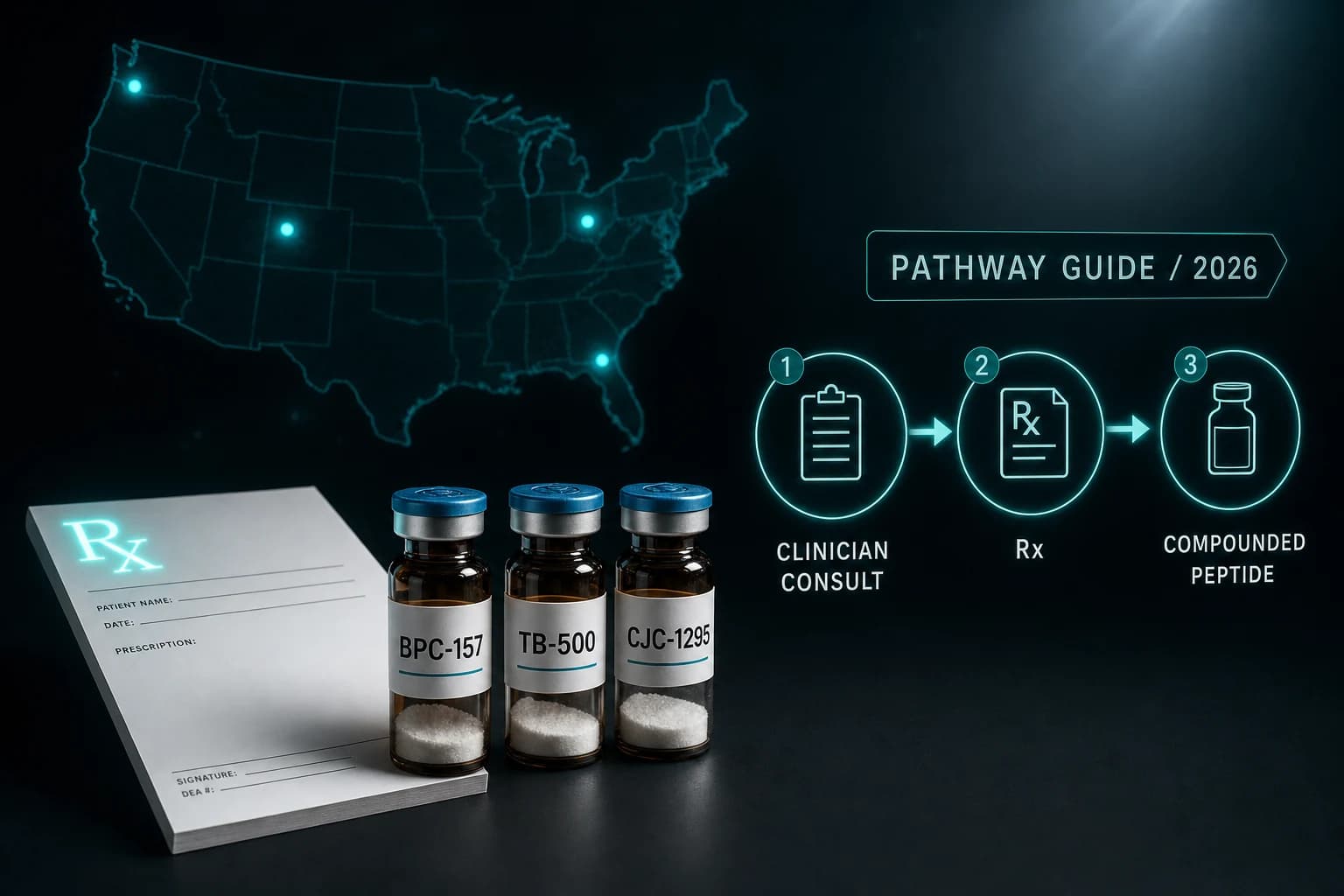
The Feb 27, 2026 FDA peptide reclassification restored legal compounding-pharmacy access to 14 peptides including BPC-157, TB-500, CJC-1295, Ipamorelin, GHK-Cu, KPV, and the GH secretagogues. For patients interested in compounded peptide therapy, the practical question is how to navigate from "I want to try this compound" to "I have a prescription and a pharmacy preparing it."
This article covers the clinician landscape, the prescription process, how to choose a compounding pharmacy, what costs to expect, and what compounded peptide therapy looks like versus the research-grade retail alternative.
The compounding pharmacy regulatory framework
US compounding pharmacies operate under two different regulatory categories:
| Type | Operates under | Produces | Typical scope |
|---|---|---|---|
| 503A compounding pharmacy | FDCA Section 503A | Patient-specific compounded preparations | One prescription at a time |
| 503B outsourcing facility | FDCA Section 503B | Larger-batch compounded products | Multiple prescriptions, hospital supply |
503A pharmacies prepare custom formulations for individual patient prescriptions. The clinician writes a prescription specifying the compound, dose, and dosing schedule. The pharmacist compounds that specific preparation for that specific patient. 503B facilities operate at larger scale but are subject to additional FDA oversight including cGMP compliance.
For peptide therapy, most patient access goes through 503A pharmacies because each patient typically requires a specific dose and protocol tailored to their clinical situation. The Feb 2026 reclassification expanded the list of peptides that 503A pharmacies can use as bulk drug substances.
Finding a clinician who prescribes peptides
The clinician landscape for peptide prescribing has expanded substantially through 2024-2026. The five most common prescriber types:
Functional medicine physicians. Functional medicine has been the longest-tenured clinical home for peptide therapy. Functional medicine physicians typically have training in nutritional medicine, hormone optimization, and integrative approaches. Peptide therapy fits the functional medicine framework readily. The Institute for Functional Medicine maintains a clinician directory.
Anti-aging and longevity clinics. Specialized anti-aging clinics typically offer peptide therapy as part of broader longevity protocols. This category overlaps significantly with functional medicine but includes clinicians with specific longevity-focused training.
Sports medicine physicians. Sports medicine has increasingly incorporated peptide therapy for recovery and tissue repair applications. The athletic and post-injury populations are particularly relevant for compounds like BPC-157, TB-500, and the GH secretagogues.
Integrative medicine and hormone optimization clinics. Clinics specializing in hormone replacement therapy (HRT) and integrative approaches often add peptide therapy as a complementary intervention. The overlap with male hormone optimization (testosterone, GH support) is particularly clean.
Primary care. Following the Feb 2026 reclassification, primary care physicians have begun prescribing select peptides (most commonly compounded GLP-1s for weight management) where the clinical case is straightforward.
How to find a peptide-prescribing clinician in your area
Three practical approaches:
-
Compounding pharmacy referral networks. Most established compounding pharmacies maintain relationships with prescribing clinicians and can direct patients toward providers in their area. Calling a local compounding pharmacy and asking which clinicians they work with is often the fastest path.
-
Professional society directories. The Institute for Functional Medicine, the American Academy of Anti-Aging Medicine (A4M), and the International Peptide Society maintain clinician directories searchable by location and specialty.
-
Telehealth platforms. Several telehealth platforms specifically focus on peptide therapy and hormone optimization. The legality of telehealth peptide prescriptions varies by state; see the telehealth peptide prescription legality state-by-state article for the patchwork.
The prescription process
The typical timeline from initial contact to first dose is approximately 2-4 weeks. Steps:
1. Initial consultation (Week 1). The clinician evaluates patient history, current medications, lab work, and the specific concern being addressed. For peptide therapy, baseline labs typically include CBC, comprehensive metabolic panel, lipid panel, and hormone panel (testosterone, estradiol, thyroid). Patients with specific concerns may require additional testing.
2. Protocol design (Week 1-2). The clinician determines whether peptide therapy is appropriate and, if so, which peptide, what dose, and what duration. This may require multiple discussions if the patient is new to peptide therapy.
3. Prescription (Week 2). The clinician writes the prescription specifying the compound, dose, and quantity. The prescription goes to the compounding pharmacy of choice.
4. Compounding pharmacy preparation (Week 2-3). The pharmacy compounds the specific preparation. Standard turnaround for established compounding pharmacies is 5-10 business days. Rush orders may be available at additional cost.
5. Dispensing (Week 3-4). The pharmacy ships the prepared peptide to the patient (or the patient picks up locally). Standard ships are with cold-chain packaging where appropriate.
6. Follow-up (Month 2-3). Most prescribing clinicians require a follow-up visit at 4-12 weeks to evaluate response, adjust dose, and screen for adverse effects.
Choosing a compounding pharmacy
Not all compounding pharmacies are equivalent in peptide work. Three quality signals to evaluate:
Pharmaceutical Compounding Accreditation Board (PCAB) accreditation. PCAB-accredited pharmacies meet quality standards established by the accreditation board. Not all 503A pharmacies are PCAB-accredited; the ones that are have demonstrated additional commitment to quality systems.
Sterile compounding capability. Injectable peptides require sterile compounding (USP <797> compliance). Pharmacies without sterile compounding capability cannot legally prepare injectable peptides.
Established peptide program. Some compounding pharmacies have been preparing peptides for years and have established processes for the specific compounds. Others are newer entrants. Asking about the pharmacy's peptide-specific track record helps surface quality differences.
| Signal | Why it matters | How to check |
|---|---|---|
| PCAB accreditation | Quality system verification | Pharmacy can show accreditation certificate |
| USP <797> sterile compounding | Required for injectable peptides | Pharmacy should disclose capability |
| Established peptide program | Track record specific to these compounds | Ask how long they have compounded the specific peptide |
| Lot documentation | Traceability of bulk drug substance | Pharmacy should provide lot info on the label |
| Cold-chain shipping | Stability for peptides during transit | Confirmed by the pharmacy at order time |
Bottom line: Not all 503A pharmacies are equivalent. PCAB accreditation, sterile compounding capability, and a documented peptide program distinguish quality operators from generic compounding pharmacies that have added peptides recently.
Cost and insurance reality
Compounded peptide preparations are almost universally self-pay. Insurance coverage for compounded peptides is rare for several reasons:
- Off-label or unapproved indications. Most peptide therapy is for indications not specifically FDA-approved, which insurance typically does not cover.
- Compounded preparations broadly have limited insurance coverage. Even for approved indications, compounded preparations often face coverage challenges versus commercially manufactured drugs.
- No major-pharma sponsor. Peptides like BPC-157 do not have a manufacturer relationship that drives formulary placement and insurance contracting.
Typical cost ranges (May 2026 baseline):
| Peptide | Compounded pharmacy price | Research-grade retail equivalent | Premium |
|---|---|---|---|
| BPC-157 5mg | $80-130 per vial | $50-80 per vial | ~50% premium |
| TB-500 5mg | $90-140 per vial | $60-90 per vial | ~50% premium |
| CJC-1295/Ipamorelin combo | $100-180 per vial | $70-120 per vial | ~50% premium |
| Tesamorelin 5mg | $200-350 per vial | $150-250 per vial | ~40% premium |
| Compounded semaglutide | $150-300 per month | varies (research) | varies |
The compounding pharmacy premium reflects clinician consult fees, sterile compounding overhead, individual prescription preparation versus batch retail, and the chain of custody from bulk drug substance to dispensed prescription.
The research-grade retail comparison is included for context. The two channels serve different patient profiles and the choice is rarely purely about price. The best legit peptide vendors 2026 ranking covers the research-grade vendor evaluation.
Compounded peptide vs research-grade retail: when each makes sense
| Patient profile | Recommended channel | Reason |
|---|---|---|
| New to peptide therapy, wants clinician oversight | Compounding pharmacy | Clinical evaluation + monitoring built in |
| Patient with comorbidities, complex medication list | Compounding pharmacy | Drug interaction screening matters |
| Research lab or institutional research user | Research-grade retail | Designed for research applications |
| Self-directed user with existing peptide experience | Either channel | Personal preference and cost |
| Athlete preparing for competition (Enhanced Games context) | Compounding pharmacy | Legal documentation and prescription record |
| Patient requiring custom dose not available in retail | Compounding pharmacy | Customization is the 503A pharmacy's strength |
The two channels are complementary rather than purely competitive. Patients who want clinician-managed peptide therapy go through compounding pharmacies. Self-directed researchers and labs use research-grade retail. The Feb 2026 reclassification expanded the compounded option but did not eliminate the retail option.
What to watch out for
Five practical issues that come up frequently in compounded peptide access:
1. Pharmacy reputation matters. Some 503A pharmacies have stronger quality systems than others. PCAB accreditation, established peptide programs, and clinician referrals are reasonable quality signals.
2. Telehealth state variation is real. Federal reclassification does not directly determine state telehealth prescribing rules. Some states permit telehealth peptide prescriptions broadly; others restrict them to in-state, in-person evaluation requirements. See the telehealth peptide prescription legality state-by-state guide.
3. Compounded GLP-1 supply situation. Compounded semaglutide and tirzepatide remain widely available, but the FDA has periodically signaled concern about compounded GLP-1 quality and dosing accuracy. Patients accessing compounded GLP-1s should choose accredited 503A pharmacies and confirm dose specifications carefully.
4. Some clinicians charge significant membership fees. Peptide-prescribing clinics often operate on direct-pay or membership models. Annual membership fees of $1,000-$5,000+ are not uncommon at established functional medicine and anti-aging clinics. This is in addition to the per-prescription compounded peptide cost.
5. The five peptides still on Category 2 remain restricted. The Feb 2026 reclassification did not cover all peptides. Compounds remaining on Category 2 cannot legally be compounded through 503A pharmacies. For these compounds, the research-grade retail channel is the remaining option.
How this connects to the Enhanced Games
The Enhanced Games (May 21-24, 2026) created a high-visibility moment for compounded peptide access. Several Enhanced Games athletes have publicly disclosed obtaining their peptide stacks through licensed compounding pharmacies under medical supervision rather than through gray-market channels. This is part of the regulatory narrative that has emerged since Feb 27, 2026.
For patients interested in athletic recovery or performance peptides specifically, the same compounding pharmacy pathway is available. The compounds most commonly prescribed for athletic recovery (BPC-157, TB-500, CJC-1295/Ipamorelin) are all included in the 14 reclassified peptides. See the Enhanced Games May 24 article for the athlete-specific stack context.
FAQ
Do I need a prescription to get compounded peptides?
Yes. Compounding pharmacies operating under 503A can only prepare custom preparations for individual patient prescriptions. A clinician prescription is required. Research-grade retail peptides operate under a separate channel that does not require a prescription but is also not the same regulatory pathway.
How do I find a clinician who prescribes peptides?
Three practical approaches: (1) call a local compounding pharmacy and ask which clinicians they work with, (2) search professional society directories (Institute for Functional Medicine, A4M, International Peptide Society), or (3) use a telehealth platform specifically focused on peptide therapy. The clinician must be licensed in your state for the prescription to be valid.
What does compounded peptide therapy cost?
Compounded peptide preparations typically run 30-60% above research-grade retail equivalents. Initial clinician consultations are often $300-$800 depending on the specialty and depth of evaluation. Follow-up visits are typically $150-$400. Some clinics operate on annual membership models with fees of $1,000-$5,000+. Insurance coverage for compounded peptides is rare.
What is the difference between 503A and 503B compounding?
503A compounding pharmacies prepare patient-specific custom preparations one prescription at a time. 503B outsourcing facilities prepare larger-batch compounded products and are subject to additional FDA oversight including cGMP compliance. Most peptide patient access goes through 503A pharmacies.
Are compounded peptides safe?
Quality varies by pharmacy. PCAB accreditation, USP <797> sterile compounding capability, and an established peptide-specific track record are reasonable quality signals. Patients should ask about pharmacy credentials and lot documentation. The Feb 2026 reclassification cleared the regulatory access pathway but did not change pharmacy-specific quality variation.
Which peptides are now compoundable?
The Feb 27, 2026 reclassification restored 14 of 19 peptides to Category 1, including BPC-157, TB-500, CJC-1295, Ipamorelin, KPV, GHK-Cu, Sermorelin, MOTS-c, Selank, Semax, Tesamorelin, and others. Five peptides remained on Category 2 pending additional safety review. See the FDA peptide reclassification complete breakdown for the full list.
Can I get compounded semaglutide?
Yes, compounded semaglutide remains widely available through licensed compounding pharmacies in 2026, though the FDA has periodically signaled concern about compounded GLP-1 quality and dosing accuracy. Patients should choose accredited 503A pharmacies and verify dose specifications carefully.
Further reading
- FDA peptide reclassification February 2026 complete breakdown
- Telehealth peptide prescription legality state-by-state 2026
- FDA 503A peptide compounding review July 2026
- Best legit peptide vendors 2026
- Where to buy BPC-157 with COAs
- Enhanced Games May 24 2026 opening-day stacks and stakes
This article is for educational and informational purposes only. None of the content above constitutes medical advice. Patients interested in compounded peptide therapy should consult a qualified clinician licensed in their state who can evaluate appropriateness for their specific situation. Insurance coverage for compounded peptide preparations varies by insurer and is rarely available for off-label uses.