At a glance
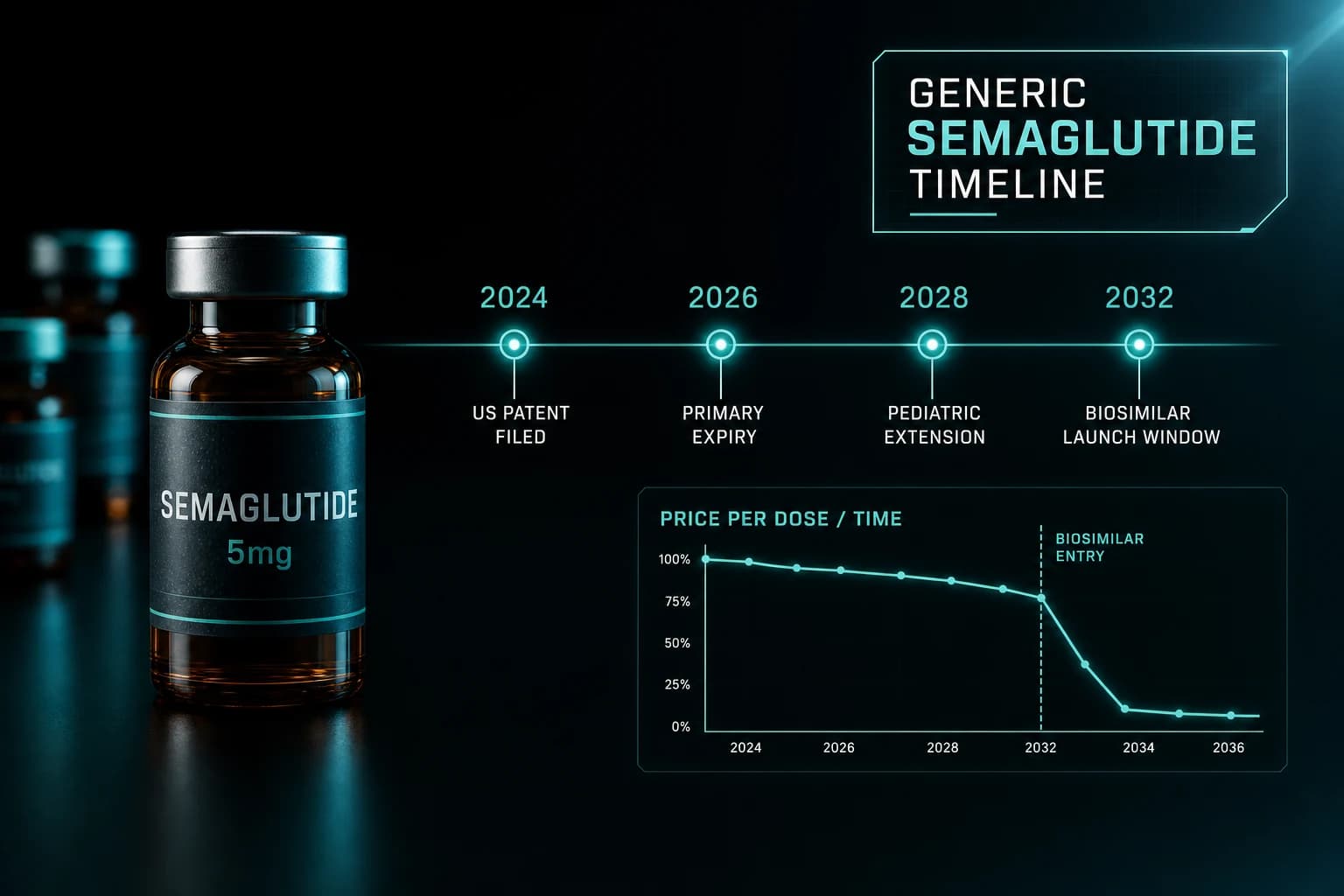
- US composition-of-matter patent on semaglutide expires in early 2032; multiple secondary patents and exclusivities extend protection on specific formulations
- Canada generic semaglutide launches expected as early as January 2026 following Canadian patent expiry; first generics arrived through Q1 2026
- India launched generic semaglutide in March 2026 ahead of major Western markets; pricing roughly 1/20th of US branded equivalent
- Biosimilar pathway in the US requires BPCIA application; several biosimilar developers have publicly disclosed development programs targeting 2027-2030 launches
- The compounded semaglutide market in 2026 reflects current GLP-1 demand and pricing pressure; generic launch will reshape both branded and compounded segments substantially
The generic semaglutide timeline is the single biggest medium-term economic question in the GLP-1 class. The US composition-of-matter patent on semaglutide expires in early 2032, which is when generic competitors can enter the US market with bioequivalent versions. But the actual generic timeline is more layered than the patent calendar suggests, because international markets are reaching expiry earlier, biosimilar developers are progressing, and the compounded semaglutide market has already created a partial price competition picture.
This article covers the patent and exclusivity layers, the international generic launch sequence already underway, the US biosimilar pathway and timeline, and what each stage of the generic transition will likely do to GLP-1 pricing and access.
The semaglutide patent landscape
Novo Nordisk's semaglutide intellectual property portfolio consists of multiple overlapping patents and regulatory exclusivities:
| Layer | Approximate US expiration | What it protects |
|---|---|---|
| Composition-of-matter patent | Early 2032 | The semaglutide molecule itself |
| Method-of-use patents | 2031-2033 | Specific dose escalation protocols |
| Formulation patents (Rybelsus / SNAC) | 2031-2034 | Specific oral and injectable formulations |
| Regulatory exclusivity | Variable | Additional protection beyond patent |
| Pediatric extension | +6 months | Triggered by pediatric trial data |
The composition-of-matter patent is the primary barrier to generic entry. Once it expires, other manufacturers can produce semaglutide bioequivalent drugs (for small-molecule generics) or biosimilar drugs (for biologics-equivalent products). The various secondary patents and exclusivities can delay generic competition for specific formulations or specific indications, but they generally do not block generic semaglutide as a category.
For Wegovy (semaglutide 2.4 mg) and Ozempic (semaglutide 1 mg) specifically, the composition-of-matter expiry in 2032 is the inflection point most observers focus on.
The international generic landscape (already happening)
Several international markets reached patent expiry earlier than the US:
Canada. Canadian patent expiry occurred in early 2026. Multiple generic semaglutide manufacturers have launched products through Q1 2026, with pricing approximately 40-60% below branded Ozempic in Canadian markets. The Canadian launches are the most direct comparison point for what US patent expiry may produce.
India. Indian patent law and pricing structure produced earlier generic entry than Western markets. Indian generic semaglutide launched in March 2026 at approximately 1/20th the US branded price. Indian generics serve domestic and emerging-market demand and are typically not directly available in the US through legal channels.
Other emerging markets. Latin American, Southeast Asian, and African markets have variable patent and generic timelines. Several major generic manufacturers have signaled intent to launch semaglutide generics across multiple markets through 2026-2028.
Europe. European patent expiry runs roughly parallel to US expiry (early 2032). EU biosimilar pathway will likely produce launches shortly after expiry.
The international launches do not directly affect US pricing because the regulatory pathways are separate. They do create:
- Price comparison points that influence US conversations
- Manufacturing infrastructure that will be ready when US patents expire
- Patient awareness of the eventual US generic option
| Market | Patent expiry | Generic launch | Approximate price vs US branded |
|---|---|---|---|
| Canada | Early 2026 | Q1 2026 | 40-60% below branded |
| India | Earlier (different IP structure) | March 2026 | ~1/20th |
| US | Early 2032 | Expected 2032-2033 | TBD |
| EU | Early 2032 | Expected 2032-2033 | TBD |
The US biosimilar pathway
Semaglutide is a peptide, which sits at an interesting boundary between traditional generic drugs and biologics. The regulatory pathway depends on FDA classification:
If treated as a small-molecule generic. The Hatch-Waxman pathway (505(j) ANDA) requires demonstrating bioequivalence to the reference product. This is the faster and cheaper pathway. Bioequivalence demonstrations for peptide products are technically more demanding than for small molecules but established methodologies exist.
If treated as a biologic. The biologic pathway (BPCIA, 351(k) application) requires demonstrating biosimilarity through more extensive analytical and clinical comparability work. Biosimilar development is more expensive and time-consuming.
As of May 2026, the FDA has signaled the peptide products of semaglutide's molecular size are likely to be classified as biologics under the 2020 BPCIA transition framework. Biosimilar development for GLP-1 peptides has been publicly disclosed by several manufacturers including some major generics companies.
Expected biosimilar timeline:
| Phase | Approximate timeline |
|---|---|
| BPCIA application submission | Pre-patent expiry (2030-2031) |
| FDA review | 12-18 months |
| Biosimilar approval | Around or shortly after patent expiry (2032-2033) |
| Market launch | 2032-2034 |
Multiple biosimilar developers have signaled ongoing programs. The competition once biosimilars are approved is likely to produce substantial price erosion versus branded products.
Compounded semaglutide as a current price point
The compounded semaglutide market is not a "generic" in the formal regulatory sense but has functioned as a price competition channel through 2023-2026.
| Channel | Approximate monthly cost (2026) | Status |
|---|---|---|
| Branded Wegovy (cash pay, no insurance) | $1,000-$1,400/month | FDA approved |
| Branded Wegovy (with manufacturer coupon, eligible patients) | $500-$650/month | FDA approved |
| Compounded semaglutide (telehealth-prescribed) | $150-$400/month | Compounded, regulatory scrutiny |
| Indian generic semaglutide | ~$30-$60/month | Generic (international, not legal US import) |
The compounded market emerged during the GLP-1 shortage period that began in 2022. With supply largely normalized but pricing pressure persisting, the compounded segment continues to serve patients priced out of branded products.
The FDA has taken periodic action to constrain compounded GLP-1 marketing and quality concerns. The state-level scrutiny covered in the telehealth peptide prescription legality state-by-state article reflects this. Whether compounded semaglutide remains widely available through 2026-2027 depends partly on FDA enforcement priorities and partly on the shortage classification status.
For our coverage of compounded GLP-1 dosing, see the GLP-1 dosing comparison 2026 and the Wegovy HD 7.2 mg STEP UP trial guide.
What the generic transition will likely do
Three predictable effects when US generics arrive in 2032-2034:
Branded price erosion. Branded semaglutide prices will likely fall substantially as generics enter the market. Historical patterns for biosimilar competition show first-biosimilar discounts of 20-40% below brand, with further erosion over 24-36 months. For semaglutide, the magnitude could be larger given the demand scale.
Insurance coverage expansion. As prices drop, insurance formularies will likely move semaglutide from restricted or non-covered status to broader coverage. Medicare Part D coverage for weight management may follow if pricing makes the cost-per-quality-adjusted-life-year math acceptable.
Compounded market reshaping. When generic semaglutide is available at lower price points through licensed pharmacies, the compounded market loses its primary price competition rationale. The compounded segment will likely shrink substantially once US generics are commercially established.
Class-wide pricing pressure. Tirzepatide, retatrutide, and CagriSema are not affected directly by semaglutide patent expiry. But the pricing competition from cheaper semaglutide will create downward pressure on the entire GLP-1 class as patients with formulary choice trade up or down based on cost-effectiveness.
Bottom line: The 2032 US patent expiry is the inflection point most likely to reshape GLP-1 pricing. International markets and the compounded segment are providing partial price competition pictures in the meantime, but the magnitude of the US generic transition will be substantially larger than current alternatives suggest.
Tirzepatide and retatrutide on different timelines
Tirzepatide (Mounjaro/Zepbound) has a later patent expiry than semaglutide. Lilly's US tirzepatide composition-of-matter patent expires approximately 2036-2037, with secondary patents extending protection on specific formulations further. Generic tirzepatide is therefore several years behind generic semaglutide.
Retatrutide is even further out. The triple agonist is currently in Phase 3 and not yet approved. Patent protection on retatrutide will extend into the 2040s once approved.
The implication: the GLP-1 class as a whole faces a multi-stage generic transition. Semaglutide first (2032), tirzepatide later (2036-2037), retatrutide later still (2040+). Each transition will reset competitive economics for the products that remain under patent.
For our coverage of the full GLP-1 dose-response landscape including these compounds, see the GLP-1 dosing comparison 2026 and the retatrutide where-to-buy guide.
What this means for patients
Three practical implications for patients planning long-term GLP-1 therapy:
1. Generic semaglutide is the medium-term affordability path. Patients on semaglutide who tolerate it well and can afford the next 5-6 years of branded pricing will see substantial cost relief once generics launch in 2032. Patients struggling with current pricing have shorter-term options: manufacturer coupons, insurance appeals, switching to compounded preparations through legitimate compounding pharmacies, or international supply (where legal).
2. Tirzepatide remains the most-effective approved option but has later generic timeline. Patients prioritizing maximum weight loss should weigh the trade-off between tirzepatide's higher efficacy and its longer time to generic competition. Switching from tirzepatide to generic semaglutide in 2032 is a viable downgrade-but-affordable path.
3. Retatrutide adoption decisions will continue to involve cost. If retatrutide is approved with Phase 2 efficacy intact, branded pricing through the 2040 patent window will likely be premium relative to even branded semaglutide. Cost-effectiveness math will be a meaningful patient-level consideration.
Sourcing context
For research-grade semaglutide vials with public per-batch COAs (the research-use channel), Ascension Peptides ships injectable semaglutide with 50% off using code ENHANCED. The semaglutide reconstitution chart covers dose-by-volume math.
For prescription compounded semaglutide through licensed compounding pharmacies, see the compounding pharmacy peptide access guide 2026.
FAQ
When will generic semaglutide be available in the US?
US composition-of-matter patent on semaglutide expires in early 2032. Generic launches are expected in 2032-2033, depending on biosimilar approval timelines and patent litigation outcomes. Multiple manufacturers have publicly disclosed development programs targeting this window.
Is generic semaglutide already available in other countries?
Yes. Canadian generic semaglutide launched in Q1 2026 after Canadian patent expiry. Indian generic semaglutide launched in March 2026 at approximately 1/20th the US branded price. International generics are not legally importable to the US through standard channels.
What is the difference between generic and biosimilar?
A generic drug is a chemically identical copy of the reference small-molecule drug. A biosimilar is a "highly similar" biologic product made through analytical and clinical comparability work to a reference biologic. Semaglutide is at the boundary; the FDA appears to be treating it under the biosimilar pathway (BPCIA), which is more rigorous than the standard generic pathway.
Will compounded semaglutide be affected by generic launches?
Yes. When generic semaglutide is available through licensed pharmacies at lower prices than current compounded options, the compounded market loses its primary price competition rationale. The compounded segment will likely shrink substantially once US generics are commercially established (2032+).
How much cheaper will generic semaglutide be?
Historical biosimilar discounts run 20-40% below branded at first launch, with further erosion over 24-36 months. For semaglutide given the demand scale, the magnitude could be larger. Some forecasters project 50-70% price erosion within 36 months of US generic launch.
What about tirzepatide and retatrutide generics?
Tirzepatide composition-of-matter patent expires approximately 2036-2037 with secondary patents extending further. Retatrutide is still in Phase 3; once approved, patent protection extends into the 2040s. The GLP-1 class is on staggered generic timelines spanning approximately 2032-2042.
Can I get Indian generic semaglutide legally in the US?
No. Importing prescription pharmaceuticals from outside the US generally requires an FDA-approved pathway, which Indian generic semaglutide does not have. The FDA may exercise enforcement discretion for small personal-use quantities in some cases, but the legal default is that international generic GLP-1s cannot be legally imported for US use.
Further reading
- GLP-1 dosing comparison 2026: from 2.4 mg to 7.2 mg and beyond
- Wegovy HD 7.2 mg STEP UP trial guide
- FDA peptide reclassification February 2026 complete breakdown
- Compounding pharmacy peptide access guide 2026
- Telehealth peptide prescription legality state-by-state 2026
- Tirzepatide vs Semaglutide 2026 head-to-head
- Retatrutide where to buy 2026
- Best legit peptide vendors 2026
This article is for educational and informational purposes only. The generic semaglutide timeline described is based on publicly disclosed patent expirations and biosimilar development programs as of May 2026. Patent litigation outcomes, regulatory decisions, and commercial factors may alter the actual timeline. None of the content above constitutes investment advice or medical advice. Patients should consult qualified professionals for individual clinical or financial questions.