At a glance
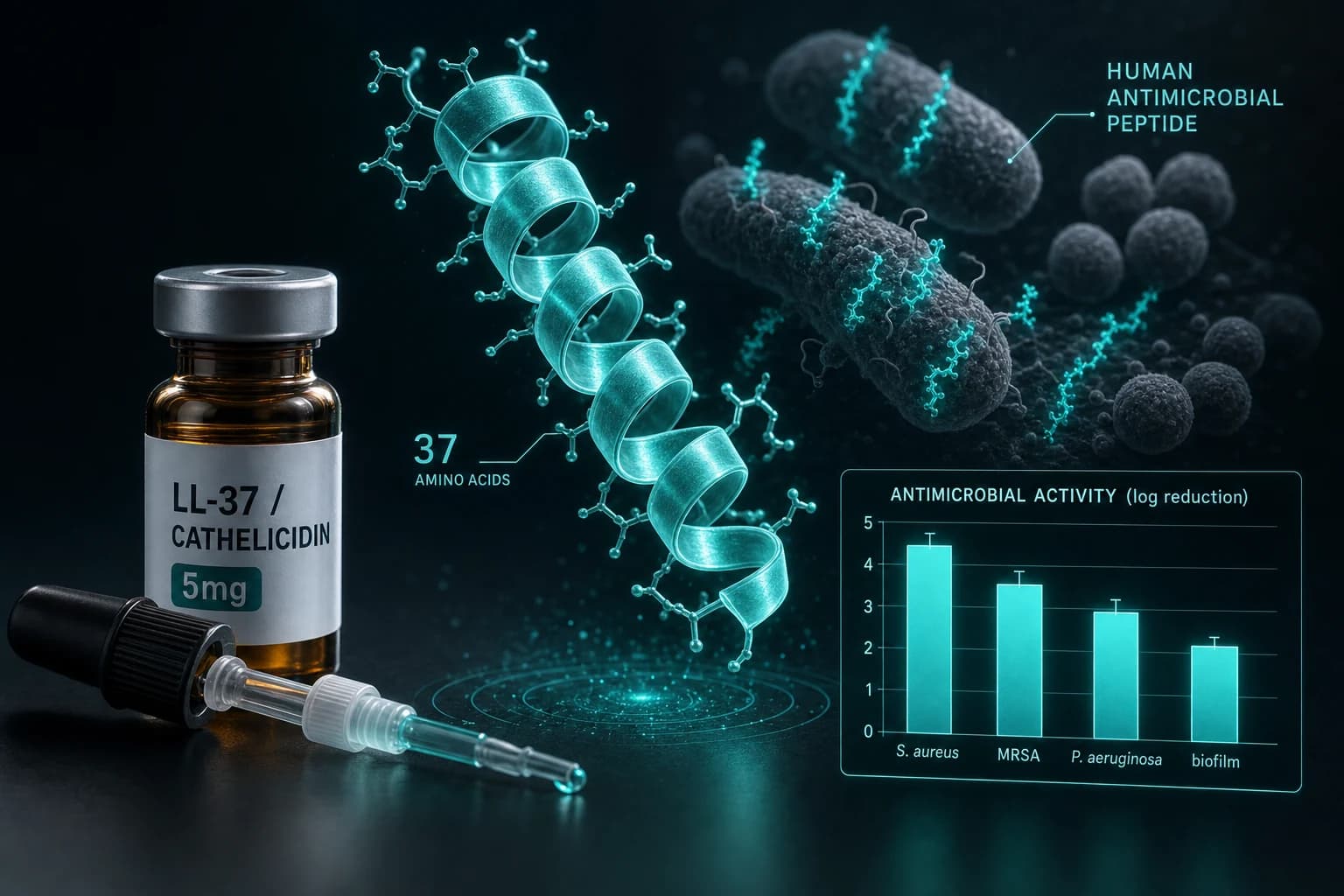
- LL-37 is the only human member of the cathelicidin family of antimicrobial peptides; 37 amino acids cleaved from the hCAP-18 precursor
- Active against Staphylococcus aureus, MRSA, Pseudomonas aeruginosa, biofilms, and a broad spectrum of bacteria and fungi
- Beyond antimicrobial action: drives wound re-epithelialization, angiogenesis, and granulation tissue formation
- Strongly expressed at the edges of acute wounds but reduced in chronic non-healing ulcers, contributing to failure of those wounds to close
- Standard research applications use topical formulation at the wound site; systemic injection is uncommon outside specific research contexts
LL-37 is the human body's own broad-spectrum antimicrobial peptide. It is endogenous, produced by neutrophils, keratinocytes, and epithelial cells in response to injury or infection. The 37-amino-acid peptide is the only member of the cathelicidin family that humans produce, and it sits at the intersection of innate immunity, wound healing, and tissue regeneration. The research interest in LL-37 as a therapeutic compound comes from a simple observation: it is strongly expressed at the edges of acute healing wounds but deficient in chronic non-healing ulcers. Restoring topical LL-37 may help close wounds that are otherwise stuck.
This article covers what LL-37 is, the mechanism of action across antimicrobial and tissue-healing pathways, the published preclinical and clinical work supporting topical research applications, and the practical considerations for research-grade dosing.
What LL-37 actually is
LL-37 is a 37-amino-acid cationic alpha-helical peptide cleaved from the C-terminal end of the hCAP-18 (human cationic antimicrobial protein 18) precursor. The mature peptide starts with two leucines (LL) and contains 37 residues total, hence the name.
| Property | LL-37 value |
|---|---|
| Sequence | 37 amino acids, cationic alpha-helical |
| Source | hCAP-18 precursor, cleaved by proteinase 3 in neutrophils |
| Structure | Single alpha-helix, amphipathic |
| Origin | Endogenous; produced by neutrophils, keratinocytes, epithelial cells |
| Family | Cathelicidin (only human member) |
| Mechanism | Membrane disruption + immunomodulation + wound healing |
LL-37 is one of the most-studied human antimicrobial peptides. The 2003 review by Bals & Wilson, Cell Mol Life Sci covers the broad biology of the cathelicidin family and LL-37's specific role in human innate immunity.
The dual mechanism: antimicrobial plus wound healing
LL-37's research interest is the combination of two normally separate functions in one molecule.
Antimicrobial activity. LL-37 binds bacterial cell membranes through electrostatic interaction (the peptide is cationic, bacterial membranes are anionic) and disrupts them through alpha-helical insertion. The result is rapid bacterial cell death. Active against:
- Gram-positive bacteria including Staphylococcus aureus and MRSA
- Gram-negative bacteria including Pseudomonas aeruginosa and E. coli
- Bacterial biofilms (notably resistant to most antibiotics)
- Some fungi including Candida albicans
- Selected enveloped viruses
The polymicrobial wound research by Thomas et al., 2013 showed LL-37 as a potential treatment for polymicrobially infected wounds, combining antimicrobial action against multiple bacterial species with the additional wound-healing properties.
Wound healing. Separately from the antimicrobial action, LL-37 drives multiple tissue-healing processes:
-
Re-epithelialization. Heilborn et al., J Invest Dermatol, 2003 showed LL-37 is strongly expressed at the wound edge early in acute wound healing and is involved in re-epithelialization. Chronic ulcer epithelium showed deficient LL-37, suggesting the peptide's absence contributes to the failure to heal.
-
Angiogenesis. Koczulla et al., J Clin Invest, 2003 demonstrated LL-37 induces angiogenesis through formyl peptide receptor-like 1 (FPRL1) on endothelial cells, producing neovascularization in chorioallantoic membrane assays and in a rabbit hind-limb ischemia model.
-
Granulation tissue formation. Multiple studies including Carretero et al., J Invest Dermatol, 2008 showed LL-37 significantly improved re-epithelialization and granulation tissue formation in excisional wound models.
-
Keratinocyte apoptosis suppression. Chamorro et al., 2008 showed LL-37 suppresses apoptosis in keratinocytes, supporting the cellular machinery needed for wound closure.
The combination of antimicrobial action plus pro-healing effects is what makes LL-37 distinctive. Most antimicrobials kill bacteria but do not actively help the wound close. LL-37 does both.
Bottom line: LL-37 acts at the same wound site through two complementary pathways - kills bacteria while actively promoting epithelial closure, angiogenesis, and granulation. This dual action is what positions the compound for chronic-wound research, where infection and impaired healing typically co-occur.
Why chronic wounds are LL-37 territory
The most-studied research application is chronic non-healing ulcers. The mechanism rationale is direct:
- Healthy acute wounds upregulate LL-37 at the wound edge during the first 48-72 hours.
- Chronic non-healing wounds show LL-37 deficiency at the wound edge.
- The deficiency contributes to both impaired bacterial clearance and impaired epithelial closure.
- Restoring local LL-37 may address both deficits simultaneously.
Heilborn et al., 2003 provided the original observation linking LL-37 deficiency to chronic wound failure. Subsequent work has tested topical LL-37 supplementation in animal and limited human models.
Stability in chronic wound environment. A concern for any peptide used topically in a wound is degradation by tissue proteases. Sigurdardottir et al., J Invest Dermatol, 2011 showed LL-37 was degraded by trypsin but was reasonably resistant to proteolytic cleavage ex vivo by chronic wound fluid from non-healing venous leg ulcers, suggesting topical LL-37 could maintain functional concentration at the wound site for the relevant treatment window.
The standard research protocol
LL-37 research applications are mostly topical. The compound is applied at the wound site rather than dosed systemically. Standard research-use formulations include:
| Format | Concentration | Application | Frequency |
|---|---|---|---|
| Topical hydrogel | 100-500 μg/mL | Apply to wound site | Once or twice daily |
| Topical solution | 50-200 μg/mL | Drop or spray onto wound | Once or twice daily |
| Injection (rare research use) | 100-500 μg | Subcutaneous or intramuscular | Variable |
The injectable route is uncommon outside specific research contexts because:
- Systemic LL-37 has a short half-life
- The mechanism is most directly observable at the local wound site
- Endogenous LL-37 normally functions in tissue, not in circulation
For research-grade applications, the reconstitution calculator handles dose-by-volume math when converting lyophilized vials to topical concentrations.
LL-37 versus other wound-healing peptides
| Compound | Primary mechanism | Best research target | Format |
|---|---|---|---|
| LL-37 | Antimicrobial + re-epithelialization + angiogenesis | Chronic non-healing wounds, infected wounds | Topical (research) |
| BPC-157 | Growth factor upregulation, angiogenesis | Tendon, ligament, ulcer healing | Injectable (research) |
| TB-500 | Cell migration, systemic actin regulation | Recovery, tissue repair (systemic) | Injectable (research) |
| GHK-Cu | Collagen synthesis, matrix remodeling | Skin, hair, wound healing | Topical + injectable |
| Pentadeca arginate (PDA) | Same as BPC-157, better oral stability | GI healing, recovery | Oral + injectable |
LL-37 occupies a distinctive niche: chronic wound research and infected wound research, where the combination of antimicrobial and pro-healing effects produces additive benefit that no other peptide replicates in the same molecule.
Combining LL-37 with other peptides
LL-37 has not been formally studied in research-stack protocols. The mechanistic rationale for combinations:
-
LL-37 + GHK-Cu (topical): Both act locally on skin and wound tissue. LL-37 handles antimicrobial and re-epithelialization; GHK-Cu handles collagen synthesis and matrix remodeling. The combination addresses the full wound-closure pipeline.
-
LL-37 (topical) + BPC-157 (subcutaneous): Local antimicrobial and re-epithelialization plus systemic tissue repair and angiogenesis support. Useful for serious wounds where both local infection control and systemic repair signaling matter.
-
LL-37 (topical) + Thymosin α-1 (subcutaneous): Local antimicrobial plus systemic immune modulation. Relevant for chronic wound research in immunocompromised models.
None of these combinations have published trial data; mechanism extrapolation is the rationale.
Safety and known limitations
In rodent studies and limited clinical work, LL-37 has been generally well-tolerated at topical doses. Three considerations:
Cytotoxicity at high concentrations. LL-37 can damage host cells at sufficiently high concentrations because the membrane-disrupting mechanism is not perfectly selective for bacterial membranes. Research-use concentrations stay well below the cytotoxic threshold for keratinocytes and fibroblasts.
Inflammation modulation can cut both ways. LL-37 can promote inflammation under some conditions (psoriasis, rosacea) where chronic LL-37 elevation contributes to pathology. Topical short-term use for acute wound healing is mechanistically distinct from chronic LL-37 overexpression.
Limited human RCT data. Most human LL-37 evidence is observational (expression patterns in healing vs non-healing wounds) rather than interventional. Phase 2/3 trials of exogenous LL-37 as a wound treatment have not been extensively published.
How LL-37 fits the 2026 regulatory landscape
LL-37 is not among the peptides reclassified in the February 27, 2026 HHS announcement. It remains a research compound. Some compounding pharmacies offer LL-37 in topical formulations for veterinary and limited research use; the regulatory status varies by jurisdiction.
For research-grade applications, LL-37 is available through retail peptide vendors with research-use disclosures.
Sourcing
For research-grade LL-37, Ascension Peptides carries it in the research peptide catalog with 50% off using code ENHANCED. For our broader sourcing analysis, see the best legit peptide vendors 2026 ranking.
FAQ
What is LL-37?
LL-37 is a 37-amino-acid antimicrobial peptide cleaved from the human cathelicidin precursor hCAP-18. It is the only cathelicidin produced by humans. The peptide combines broad-spectrum antimicrobial activity with wound-healing functions including re-epithelialization, angiogenesis, and granulation tissue formation.
What conditions has LL-37 been studied for?
The most-studied research application is chronic non-healing wounds, particularly venous leg ulcers and diabetic foot ulcers, where the natural expression of LL-37 is deficient. Additional research has covered infected wounds, biofilm-associated infections, and angiogenesis in ischemic tissue models.
Is LL-37 topical or injectable?
Most research-use protocols are topical, applied directly to the wound or affected tissue. The injectable route is uncommon outside specific research contexts. Because the mechanism is most directly observable at the local tissue site and endogenous LL-37 normally functions in tissue rather than circulation, topical application better mirrors the physiological role.
How does LL-37 compare to traditional antibiotics?
LL-37 kills bacteria through membrane disruption, a mechanism that bacteria find difficult to develop resistance against (unlike target-specific antibiotics where single mutations can confer resistance). LL-37 also has activity against biofilms, which are typically resistant to traditional antibiotics. The downside is that LL-37 is a peptide and degrades faster than small-molecule antibiotics, so the practical dosing window is shorter.
Can LL-37 be combined with GHK-Cu for skincare?
This is a mechanistically reasonable combination for skin research, where LL-37 contributes antimicrobial and re-epithelialization action while GHK-Cu contributes collagen synthesis and matrix remodeling. No formal combination trials have been published. The combination has been used by some compounding pharmacies in custom topical formulations.
Why is LL-37 not more widely used clinically?
The compound has not received Phase 3 development for any indication despite the strong preclinical evidence base. The reasons are partly commercial (peptide stability and manufacturing scaling) and partly regulatory (chronic wounds are a difficult endpoint to standardize across trials). Several biotech sponsors have explored LL-37-derived analogs at smaller scales without a major-pharma development program.
Is LL-37 legal?
LL-37 is sold for research purposes by peptide vendors under research-use disclosures. It is not approved by the FDA for any indication. Some compounding pharmacies offer topical formulations in jurisdictions where it is permitted for veterinary or specific research applications.
Further reading
- BPC-157 compound guide
- GHK-Cu compound guide
- Wolverine Stack: BPC-157 + TB-500 recovery protocol
- GLOW Blend: GHK-Cu + BPC-157 + TB-500 skin recovery
- KPV oral peptide gut inflammation research
- Pentadeca arginate (PDA): BPC-157 successor research
- Best legit peptide vendors 2026
- Reconstitution Calculator
This article is for educational and research purposes only. LL-37 is sold under research-use disclosures and is not approved by the FDA for any indication. None of the content above constitutes medical advice. Consult a qualified clinician for individual medical questions about wound care or infectious diseases.