At a glance
- SURPASS-CVOT (Nicholls et al., NEJM 2025) randomized more than 13,000 adults with T2D and atherosclerotic CVD to tirzepatide or dulaglutide, median follow-up ~4 years
- Three-point MACE fell 8% on tirzepatide (12.2% vs 13.1%; HR 0.92, 95.3% CI 0.83 to 1.01): noninferiority met, superiority missed (P=0.09)
- All-cause mortality was 16% lower on tirzepatide (HR 0.84, 95% CI 0.75 to 0.94), a positive hierarchical secondary endpoint
- Expanded MACE-4 adding coronary revascularization was significantly reduced on tirzepatide (HR 0.88)
- Tirzepatide produced 7.1 percentage points more weight loss (-11.6% vs -4.5%) and slowed eGFR decline in the high-risk CKD subgroup
- Tirzepatide is not FDA-approved for cardiovascular risk reduction; SURPASS-CVOT is a research and label-update story, not a new indication yet
A head-to-head Phase 3 that quietly delivered a 16% mortality result
The cardiovascular outcomes question for tirzepatide has been open since the drug was approved. Tirzepatide's regulatory file was built on glycemic control and weight loss, not on hard cardiovascular endpoints. Every other major GLP-1 receptor agonist had a placebo-controlled cardiovascular outcomes trial on file before tirzepatide had one. That gap is now closed.
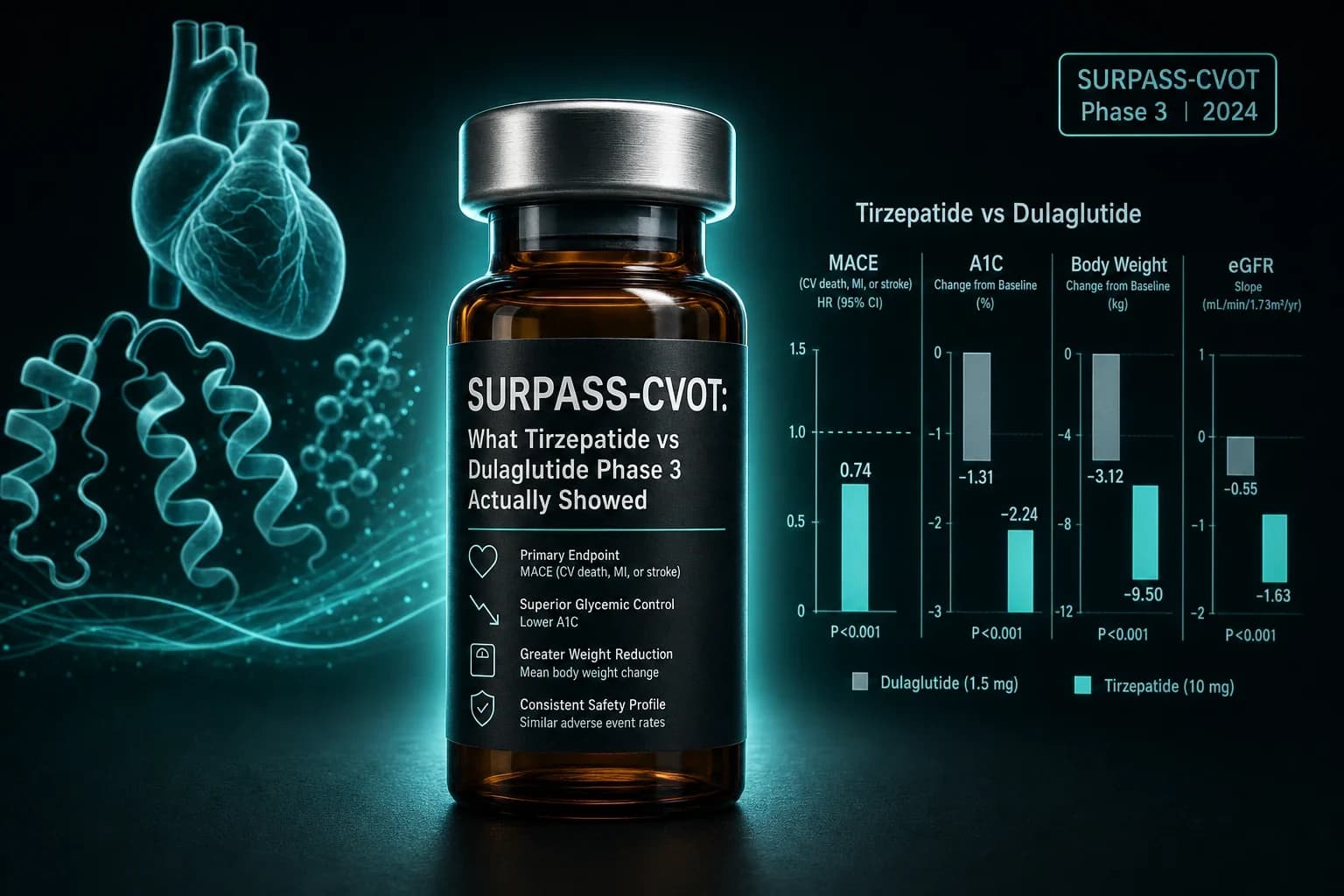
SURPASS-CVOT, published in the New England Journal of Medicine in December 2025 (Nicholls et al., NEJM 2025; 393:2409-2420, DOI 10.1056/NEJMoa2505928), randomized more than 13,000 adults with type 2 diabetes and established atherosclerotic cardiovascular disease to once-weekly tirzepatide or once-weekly dulaglutide for a median of about 4 years. The primary 3-point MACE endpoint occurred in 12.2% of patients on tirzepatide and 13.1% on dulaglutide. Hazard ratio 0.92. Tirzepatide met the prespecified noninferiority margin but did not reach superiority on the primary endpoint.
Read the hierarchical secondaries before deciding what that means. All-cause mortality was 16% lower on tirzepatide (HR 0.84, 95% CI 0.75 to 0.94). The expanded MACE-4 composite, which added coronary revascularization to the three-point endpoint, was significantly reduced (HR 0.88). Body weight, HbA1c, blood pressure, and eGFR slope in the CKD subgroup all favored tirzepatide. The honest read is that tirzepatide cleared the bar against an already-effective comparator, with directional and secondary evidence that points the same way as the placebo-controlled GLP-1 cardiovascular trials. The rest of this piece walks through the noninferiority semantics, the secondary endpoints, and what the data does and does not support.
Why SURPASS-CVOT used an active comparator instead of placebo
Most of the public cardiovascular outcomes trials people remember used placebo. SELECT compared semaglutide 2.4 mg to placebo. FLOW compared semaglutide 1.0 mg to placebo. SURMOUNT-OSA compared tirzepatide to placebo. SURPASS-CVOT did something different. Tirzepatide was tested against dulaglutide 1.5 mg, a once-weekly GLP-1 receptor agonist with its own positive cardiovascular outcomes trial on file (Gerstein et al., Lancet 2019, PMID 31189511, REWIND).
That design choice was driven by ethics and by FDA expectations. By the time SURPASS-CVOT enrolled, multiple GLP-1 agonists already had positive cardiovascular outcomes data, and dulaglutide was approved with a cardiovascular risk reduction indication in adults with type 2 diabetes. Randomizing high-risk patients to placebo when an approved cardioprotective alternative existed would have been hard to justify. Dulaglutide became the comparator.
The consequence is statistical. An active comparator absorbs part of the absolute risk reduction signal. Both arms had GLP-1 receptor agonism on board. The placebo-controlled effect size for either drug separately should be larger than the relative difference between them in a head-to-head trial. That trade-off is the price of running an ethically defensible cardiovascular outcomes trial in 2022 to 2025 instead of 2010, when no GLP-1 receptor agonist yet had a cardioprotective indication.
Note: The clean way to interpret SURPASS-CVOT is "tirzepatide is at least as good as dulaglutide for hard cardiovascular outcomes, plausibly better on mortality and expanded MACE, and meaningfully better on metabolic and renal parameters." Translating that into placebo-equivalent effect sizes requires assumptions about additive vs incretin-class effect, which the trial cannot resolve.
The SURPASS-CVOT population
The trial design paper (Sattar et al., Am Heart J 2023, PMID 37758044) reported 13,299 participants randomized at 640 sites in 30 countries across all world regions. The trial used a broad definition of atherosclerotic cardiovascular disease at entry: documented coronary, cerebrovascular, or peripheral artery disease. Mean baseline age was 64.1 years, mean diabetes duration 14.7 years, mean HbA1c 8.4%, and mean BMI 32.6 kg/m^2. At baseline, 65% had coronary artery disease (47% with prior MI, 57% with prior coronary revascularization), 19% had prior stroke, and 25% had peripheral artery disease. A meaningful subset entered with chronic kidney disease, including patients in the KDIGO high-risk or very-high-risk categories.
This is older, longer-duration, sicker T2D than the SURPASS-1 monotherapy population (Rosenstock et al., Lancet 2021, PMID 34186022) and closer to the REWIND and LEADER populations. Generalizability to the broader US T2D population has been quantified in a separate analysis (PMID 40907677), which estimated SURPASS-CVOT enrollment criteria would capture a clinically relevant fraction of adults with T2D and ASCVD seen in routine US practice.
Tirzepatide was titrated to a maximum tolerated dose of 5 mg, 10 mg, or 15 mg once weekly. Dulaglutide was administered at 1.5 mg once weekly. Concomitant standard-of-care glucose-lowering, antihypertensive, and lipid-lowering therapy was continued.
The primary endpoint and what 0.92 actually means
The primary outcome was a three-point major adverse cardiovascular event composite: death from cardiovascular causes, nonfatal myocardial infarction, or nonfatal stroke. Over a median follow-up of approximately 4 years, the event rates were:
| Endpoint | Tirzepatide | Dulaglutide | HR (95% CI) |
|---|---|---|---|
| Primary 3-point MACE | 12.2% | 13.1% | 0.92 (0.83 to 1.01) |
| Cardiovascular death | 5.6% | 6.2% | favored tirzepatide |
| Nonfatal MI | 4.7% | 5.4% | favored tirzepatide |
| Nonfatal stroke | 3.5% | 3.8% | favored tirzepatide |
| All-cause mortality | n/a | n/a | 0.84 (0.75 to 0.94) |
| Expanded MACE-4 (adds coronary revasc) | n/a | n/a | 0.88 (significant) |
Noninferiority was prespecified at a 1.05 upper bound for the HR confidence interval. The observed upper CI of 1.01 cleared that margin (P=0.003 for noninferiority). Superiority was tested at a conventional 0.05 alpha and missed (P=0.09).
A 0.92 hazard ratio with a 95.3% CI ending at 1.01 is the textbook case of a directionally favorable result that did not reach the statistical superiority threshold. The point estimate favors tirzepatide. Every individual component of the composite numerically favored tirzepatide. The mortality and expanded MACE secondaries crossed superiority. The cleanest read is that tirzepatide is at minimum noninferior and most likely modestly superior to dulaglutide on hard cardiovascular endpoints, with the uncertainty concentrated in how large that incremental superiority actually is.
Bottom line: SURPASS-CVOT did not show tirzepatide is dramatically better than dulaglutide on three-point MACE. It showed tirzepatide is at least as good, with directionally consistent benefits across components and a 16% mortality reduction that did clear superiority.
The mortality result is the part to read twice
All-cause mortality was a prespecified hierarchical secondary. The observed HR of 0.84 (95% CI 0.75 to 0.94) corresponds to roughly a 16% relative reduction. In an actively-treated comparator arm with established cardiovascular benefit, that is a notable result. It implies that even after accounting for what dulaglutide already does to mortality (the REWIND trial showed a numerical but non-significant mortality reduction versus placebo), tirzepatide adds incrementally.
Several mechanistic explanations are plausible. None are proven from outcomes data alone. Tirzepatide's GIP receptor activity may contribute to vascular and inflammatory effects beyond pure GLP-1 receptor signaling. The larger weight reduction on tirzepatide reduces visceral adiposity and cardiometabolic load. The HbA1c gap means time in glycemic target was longer. Tirzepatide also produced larger reductions in blood pressure and lipids, both of which feed into long-term mortality.
A review summarizing SURPASS-CVOT in the context of dual incretin pharmacology (Krzeminska-Fronc and Filipek, 2025, PMID 40886230) frames the GIP component as the most plausible source of incremental signal versus a pure GLP-1 receptor agonist. That framing is hypothesis-generating, not established.
Renal outcomes in the CKD subgroup
Prespecified renal analyses stratified outcomes by KDIGO risk category, with the high-risk and very-high-risk CKD strata as the population of interest. In that population, the slope of eGFR decline was less steep on tirzepatide. The mean decline at 36 months was approximately 3 mL/min/1.73 m² less on tirzepatide than dulaglutide. The directional consistency with the FLOW trial's semaglutide kidney signal is notable, although SURPASS-CVOT was not a dedicated kidney outcomes trial and is not powered as one.
The renal data does not establish a CKD indication for tirzepatide. It does provide the first randomized signal that the dual GIP/GLP-1 agonist may slow eGFR decline in the highest-risk T2D-CKD population. A dedicated tirzepatide CKD trial would still be needed for any regulatory action on the kidney indication.
Metabolic separation: weight, A1c, blood pressure, lipids
Where SURPASS-CVOT showed the cleanest separation was on the metabolic secondaries. These results align with what the SURPASS-1 through SURPASS-5 program and SURMOUNT-1 (Jastreboff et al., NEJM 2022, PMID 35658024) already established at shorter durations.
| Parameter | Tirzepatide | Dulaglutide |
|---|---|---|
| Mean body weight change | -11.6% | -4.5% |
| HbA1c reduction (vs baseline ~8.4%) | ~1.5% | ~0.7% |
| Systolic blood pressure | larger reduction on tirzepatide | smaller reduction |
| LDL and triglycerides | greater reduction on tirzepatide | modest reduction |
A 7.1 percentage point weight loss gap is consistent with prior head-to-head trials. The dose-response and the GIP-receptor-driven enhancement of energy expenditure and appetite suppression both contribute. Long-term weight maintenance over four years is itself a meaningful clinical finding, because GLP-1 weight loss durability is a question the field has been asking since the post-discontinuation regain trials showed how quickly weight returns when therapy stops.
Lipid and blood pressure differences are not trivial. Sustained reductions in systolic blood pressure of a few millimeters of mercury, sustained reductions in LDL of any magnitude, and sustained reductions in triglycerides all map to lower long-term cardiovascular event rates in epidemiologic and trial-level data. They probably contribute to the all-cause mortality separation.
Safety: more GI events, no new mechanistic signals
Safety findings in SURPASS-CVOT were consistent with the GLP-1 and dual incretin class. Gastrointestinal adverse events were more common on tirzepatide: roughly 42.5% on tirzepatide versus 35.9% on dulaglutide. Discontinuation due to adverse events was 13.2% on tirzepatide versus 10.1% on dulaglutide. Both numbers are class-typical for sustained high-dose incretin therapy.
No new safety signals emerged in the trial. Pancreatitis, gallbladder events, thyroid C-cell findings, and malignancy rates were broadly similar between arms, with no statistically significant separation that would prompt label changes. The diabetic retinopathy signal that has periodically surfaced with semaglutide did not appear in SURPASS-CVOT.
The honest framing for a researcher is that tirzepatide carries the same gastrointestinal cost as any high-potency GLP-1 receptor agonist, with slightly higher discontinuation rates than dulaglutide, balanced against larger metabolic and likely cardiovascular benefits.
Warning: SURPASS-CVOT was conducted in adults with type 2 diabetes and established atherosclerotic cardiovascular disease. The safety and efficacy of tirzepatide in adults without diabetes and without established cardiovascular disease was not tested in this trial. Generalizing the SURPASS-CVOT mortality result to obesity-without-diabetes populations is not supported by the data.
SURPASS-CVOT in the broader GLP-1 outcomes map
By 2026 the GLP-1 and dual incretin class has a substantial outcomes catalog. Direct cross-trial comparison is unsafe because each trial enrolled different populations, used different doses, and compared against different controls. But the directional map is now clear.
| Trial | Drug | Comparator | Population | Primary endpoint result |
|---|---|---|---|---|
| LEADER | liraglutide | placebo | T2D + high CV risk | 3pt MACE -13% (superior) |
| REWIND | dulaglutide | placebo | T2D +/- prior CVD | 3pt MACE -12% (superior) |
| SUSTAIN-6 | semaglutide | placebo | T2D + high CV risk | 3pt MACE -26% (superior) |
| SELECT | semaglutide 2.4 mg | placebo | obesity + prior CVD, no T2D | 3pt MACE -20% (PMID 37952131) |
| FLOW | semaglutide 1.0 mg | placebo | T2D + CKD | kidney composite -24% |
| SOUL | oral semaglutide | placebo | T2D + ASCVD/CKD | 3pt MACE -14% |
| SURPASS-CVOT | tirzepatide | dulaglutide | T2D + ASCVD | 3pt MACE -8% (noninferior, expanded MACE-4 superior) |
What SURPASS-CVOT adds to that map is the first hard cardiovascular outcomes evidence for a dual GIP/GLP-1 receptor agonist, and the first head-to-head data in a CV-outcomes context. It also indirectly informs the broader question of whether incretin co-agonism improves outcomes versus selective GLP-1 receptor agonism. The answer in SURPASS-CVOT is yes on mortality and expanded MACE, neutral on the three-point MACE primary, and yes on metabolic and likely renal axes.
The implications for the next-generation incretin pipeline are real. Retatrutide is a triple agonist (GIP, GLP-1, glucagon) with a planned cardiovascular outcomes program. CagriSema combines a GLP-1 agonist with the amylin analog cagrilintide. Mazdutide is a GLP-1/glucagon dual agonist already showing strong head-to-head metabolic separation against dulaglutide in DREAMS-2. Each will need its own outcomes trial, but the SURPASS-CVOT signal supports the broader thesis that incretin co-agonism delivers cardiovascular benefit on top of the metabolic separation already documented.
What SURPASS-CVOT does not say
Several framings of the trial in lay and social media coverage have run ahead of the evidence. The cleanest list of "what the data does not support":
- SURPASS-CVOT does not establish tirzepatide as superior to dulaglutide on three-point MACE. It establishes noninferiority and directional superiority. The P=0.09 superiority result on the primary endpoint matters for label language.
- SURPASS-CVOT does not justify using tirzepatide in obesity-without-diabetes populations for cardiovascular risk reduction. The trial enrolled T2D with ASCVD. SELECT remains the only placebo-controlled MACE trial in obesity without diabetes, and SELECT used semaglutide.
- SURPASS-CVOT does not establish tirzepatide as a kidney drug. The eGFR slope signal in the CKD subgroup is hypothesis-generating. A dedicated tirzepatide CKD outcomes trial would be needed for the kidney indication.
- SURPASS-CVOT does not equal a tirzepatide-versus-semaglutide CV outcomes comparison. Dulaglutide is the comparator. Semaglutide's CV file rests on SUSTAIN-6, SELECT, and FLOW, all placebo-controlled. A head-to-head tirzepatide vs semaglutide CV outcomes trial does not exist.
- SURPASS-CVOT does not address compounded tirzepatide. Trial product was manufactured by Eli Lilly under regulated conditions. Compounded tirzepatide is governed by separate FDA discretion under 503A and 503B pathways. The FDA 503A compounding review covers the regulatory state of compounded incretins.
The current FDA label for tirzepatide (Mounjaro for T2D, Zepbound for chronic weight management and obstructive sleep apnea) does not include a cardiovascular risk reduction indication. The SURPASS-CVOT data has been submitted for label review. A regulatory decision on adding a MACE-reduction or all-cause-mortality-reduction indication is expected during 2026. That outcome is not guaranteed.
How SURPASS-CVOT changes clinical reasoning
For clinicians weighing GLP-1 receptor agonist choice in patients with T2D and atherosclerotic cardiovascular disease, SURPASS-CVOT shifts the decision logic. Previously, semaglutide and dulaglutide had the strongest hard-outcome cardiovascular trials and tirzepatide had the strongest metabolic data. Now tirzepatide has hard-outcome data of its own, and the metabolic gap remains.
The remaining real-world considerations are cost, GI tolerability, and access. Tirzepatide carries the highest US list price among approved GLP-1 receptor agonists. Compounded access pathways have narrowed since the FDA declared the tirzepatide shortage resolved in late 2024. Dulaglutide remains widely available, with a narrower metabolic effect size. For researchers tracking peptide class evolution, the SURPASS-CVOT readout closes one of the last major outcome questions for first-generation incretins and turns the field's attention to retatrutide, oral and long-acting next-generation candidates, and combination amylin programs like CagriSema.
For researchers procuring tirzepatide vials for protocol work, Ascension Peptides is the affiliate path we recommend; use code ENHANCED for 50% off injectable peptides. For background on tirzepatide reconstitution, the tirzepatide reconstitution chart for 10 mg and 15 mg vials covers the BAC water math.
Further reading on tirzepatide and the GLP-1 outcomes map
- Tirzepatide compound guide
- Tirzepatide vs semaglutide: SURMOUNT-5 head-to-head evidence
- Tirzepatide for HFpEF: SUMMIT trial evidence
- Tirzepatide for OSA: SURMOUNT-OSA evidence
- Semaglutide for CKD: FLOW Phase 3
- Semaglutide SELECT cardiovascular MACE evidence
- GLP-1 dosing comparison 2026
- Stopping GLP-1s: weight regain and maintenance research
This article is for educational and research purposes only. None of the content above constitutes medical advice. Tirzepatide is FDA approved as Mounjaro for type 2 diabetes and as Zepbound for chronic weight management and obstructive sleep apnea. As of May 2026 it is not FDA approved for cardiovascular risk reduction; the SURPASS-CVOT submission is under regulatory review. Dulaglutide is FDA approved as Trulicity, including for cardiovascular risk reduction in adults with type 2 diabetes and cardiovascular disease or risk factors. Decisions about cardiovascular and metabolic care belong with the patient and the treating clinician.